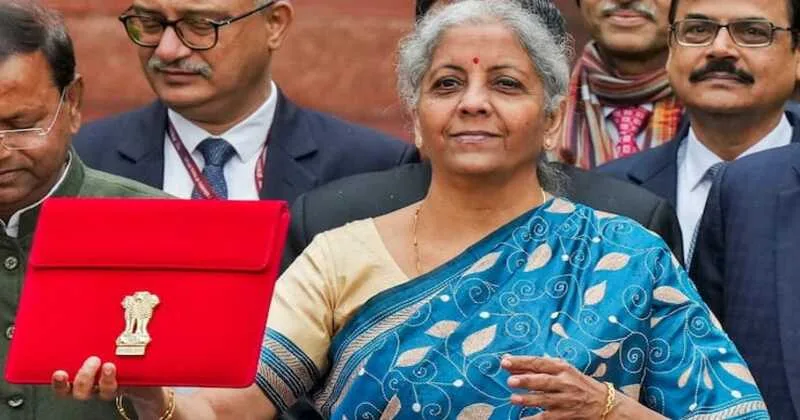
New Delhi: India is preparing for the third Union Budget of the Modi government. Union Finance Minister Nirmala Sitharaman is scheduled to present the Budget for the 2026–27 financial year on February 1, 2026. Last year, Sitharaman created history by becoming the first finance minister in India to present eight consecutive Union Budgets. She had earlier achieved another milestone in 2019 when she became India’s first full-time female Finance Minister. With the upcoming Budget, Sitharaman will move a step closer to equalling the long-standing record of former Prime Minister Morarji Desai, who presented a total of 10 Union Budgets during his political career.
Since 2017, the Union Budget has traditionally been presented on February 1 each year. This time, however, February 1 falls on a Sunday. The day also coincides with a public holiday on account of Guru Ravidas Jayanti. This has triggered speculation that the government may consider shifting the Budget presentation to another date. So far, the Centre has not issued any official clarification on whether the schedule will be altered. If the Budget is presented on February 1 despite the holiday, the stock markets are expected to remain open. A similar arrangement was made last year when the Budget was presented on a Saturday, and the equity markets functioned normally. That decision allowed investors and market participants to react immediately to Budget announcements, a move widely welcomed by traders.
Like last year, Budget 2026 carries high expectations from the stock market, the business community, and the wider public. The government has increasingly emphasised strengthening the domestic economy in response to the heavy impact of the “retaliatory tariffs” imposed by US President Donald Trump. As part of this shift, the Centre implemented what has been described as “GST 2.0,” which involved significant tax reductions across a wide range of goods and services. In the previous Budget, Sitharaman delivered substantial relief to the middle class by exempting individuals earning up to Rs 12.75 lakh annually from income tax liability under the new regime. This was followed by further concessions under GST 2.0, aimed at stimulating consumption and supporting domestic demand.
Supportive monetary policy also played a role. The Reserve Bank of India cut its key policy rates, providing additional momentum to consumption and investment.
Budget 2026 is widely expected to continue this concessional economic approach, with further tax relief measures likely to be announced to support the consumer market. The stock market, in particular, is watching closely for changes in income tax slabs. At present, individuals earning above Rs 24 lakh per year fall under the highest tax bracket of 30 per cent. There is growing expectation that the income threshold for the 30 per cent tax rate could be raised to Rs 30 lakh or even Rs 50 lakh, which would significantly ease the burden on higher-income earners and potentially boost discretionary spending.
The old income tax regime is now followed by only a small minority of taxpayers. Estimates suggest that nearly 85 to 90 per cent of taxpayers have already shifted to the new tax regime. In this context, it would not be surprising if the government announces the complete abolition of the old regime in Budget 2026.
On the fiscal front, India’s debt-to-GDP ratio stood at 56.1 per cent in the previous Budget. This year, the government is expected to bring it down further to the range of 54 to 55 per cent, reinforcing its commitment to fiscal consolidation. India’s GDP growth target for the current year is pegged at 7.3 per cent. Policymakers are expected to make announcements aimed at maintaining growth above 7 per cent in the next financial year as well. The manufacturing sector is likely to receive particular attention, in line with the government’s long-term industrial and employment objectives.
The Union Budget remains the single most important factor influencing market direction in the near term. Investors are looking to the Budget for concrete solutions to several challenges currently facing the market. Early indications were mildly positive, with the GIFT Nifty rising by 35 points in morning trade, suggesting that the Sensex and Nifty could open higher. However, multiple headwinds remain. Industrial production data is scheduled for release later this week, while fiscal deficit figures for November will also be announced. Both will provide crucial signals about the health of the economy.
Global economy remain unfavourable
Efforts to bring an end to the Russia–Ukraine war appear to be stalling. Recent talks between Trump and Ukrainian President Volodymyr Zelensky failed to produce any breakthrough. Russian President Vladimir Putin and Zelensky continue to accuse each other of obstructing peace efforts, with Putin warning that Russia would use “weapons” to achieve its objectives if Ukraine does not yield. Rising geopolitical tensions have pushed crude oil prices higher. Brent and WTI crude prices rose by up to 0.68 per cent, with Brent crossing $61 per barrel and WTI moving past $57. Gold prices, meanwhile, edged lower internationally, slipping from $4,534 to $4,514, and are expected to decline in domestic markets as well. Global equity markets are largely negative. All major US indices closed in the red, with losses of up to 0.09 per cent. Japan’s Nikkei declined by 0.39 per cent. While markets in China and Hong Kong posted gains of only up to 0.74 per cent. European markets showed mixed trends.