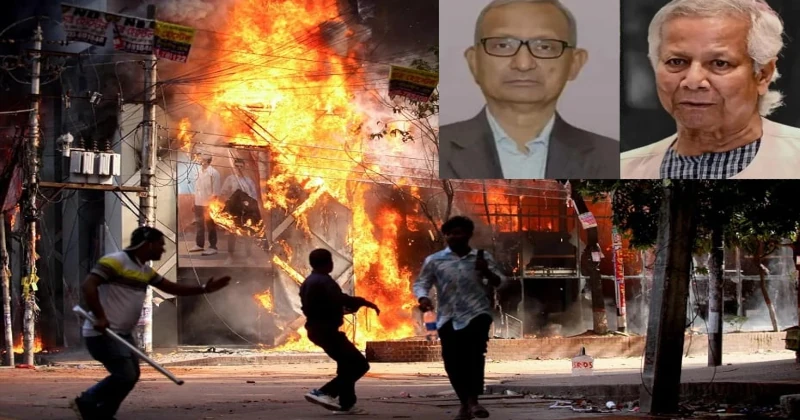
The mass resignation of advisers from Bangladesh’s interim government, headed by Muhammad Yunus, has plunged the administration into a serious political and governance crisis. The latest to step down is Khoda Baksh Chowdhury, who was overseeing the Ministry of Home Affairs. His resignation was formally accepted by the President on December 24, adding to growing concerns about the credibility of the interim arrangement.
Recent developments suggest that the government is increasingly yielding to pressure from extremist Islamic organisations. Such capitulation not only weakens institutional governance but also threatens to undermine the very foundations of stable administration. Observers warn that surrendering decision-making authority to external pressure groups risks creating a dangerous precedent at a critical political juncture. The immediate trigger for the latest resignation appears to be intense pressure from extremist groups demanding action in a case involving student leader Sharif Osman Hadi. Abdullah al-Jaber, secretary of ‘Inquilab Manja’, an organisation co-founded by Hadi, issued a 24-hour ultimatum to Interior Minister Lt Gen (retd) Md Jahangir Alam Chowdhury, calling for his resignation.
Instead of firmly addressing the unrest, the government appears to have attempted to pacify street protests by forcing out a relatively junior official, Khoda Baksh Chowdhury.
With his departure, Khoda Baksh Chowdhury becomes the fourth adviser to resign from the Yunus-led interim government. The first resignation came from student leader Nahid Islam in early 2025. This was followed by Asif Mahmood Shojib Bhuyan, Adviser to the Local Self-Government Department, and Mahfuz Alam, Adviser to the Information Department, both of whom resigned on December 10, 2025. The steady stream of exits has intensified doubts about the government’s cohesion and capacity to govern.
Taken together, these developments point to the interim government’s inability to maintain control over a rapidly deteriorating political situation. Internal power struggles, coupled with the looming general elections scheduled for February 2026, have further complicated governance. The morality, authority, and overall stability of the administration are increasingly being questioned. While officials claim that some advisers resigned in order to contest the upcoming elections, the government’s apparent submission to ultimatums issued by radical organisations remains deeply troubling. The call by the Bangladesh Nationalist Party for the resignation of the National Security Adviser underscores how sharply the government’s authority is being challenged. As the election draws closer, political uncertainty is expected to intensify.
Analysts argue that what began as a technocratic caretaker arrangement has now devolved into an administration driven by street pressure. The Yunus-led interim government, they say, resembles a large ship without a captain, adrift, vulnerable, and tossed about by political winds and turbulent waves.