





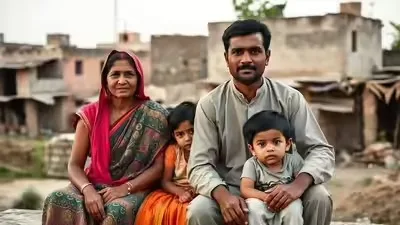
NEW DELHI: In a major acknowledgment of India’s statistical reforms, the World Bank has stated that the country’s revamped consumption survey data has played a significant role in recalibrating global poverty calculations. The observation was shared with the Parliament on Monday as part of a written reply presented by Union Minister of State for Finance Pankaj Chaudhary in the Lok Sabha.
The World Bank noted that the recent increase in international poverty estimates arises from two factors: global price fluctuations and improved country-level data. India’s enhanced survey methodologies and updated datasets have, therefore, contributed meaningfully to the accuracy of global assessments.
Sharp Decline in Extreme Poverty Over a Decade
Highlighting India’s domestic progress, Chaudhary informed the House that the country has witnessed a dramatic fall in extreme poverty between 2011-12 and 2022-23.
According to government data:
- Extreme poverty rate fell from 27.12 percent in 2011-12 to 5.25 percent in 2022-23.
- The number of people living in extreme poverty declined from 34.4 crore to 7.5 crore during the same period.
- The Minister attributed this reduction to sustained growth, targeted welfare measures and improved delivery systems that ensure benefits reach the most vulnerable.
National Multidimensional Poverty Index
To shift poverty measurement beyond income-based indicators, India uses a National Multidimensional Poverty Index (MPI) developed in alignment with global standards. The MPI incorporates indicators such as nutrition, health, education, sanitation, housing, drinking water and access to clean cooking fuel.
Referring to NITI Aayog’s discussion paper, “Multidimensional Poverty in India since 2005-06”, Chaudhary said:
- Multidimensional poverty has reduced from 29.17 percent in 2013-14 to 11.28 percent in 2022-23.
- This indicates that 24.8 crore people have risen out of multidimensional poverty in less than ten years.
- The steep reduction reflects improvements in basic amenities, expanded coverage of social schemes, and stronger delivery of public services across states.
Inclusive Growth Remains Core
Reaffirming the government’s commitment to poverty eradication, Chaudhary said inclusive development remains the cornerstone of national policy. He cited the guiding principle of “Sabka Saath, Sabka Vikas”, which steers all major welfare and economic reforms.
The government’s strategy focuses on:
- Reducing poverty and inequality
- Expanding social security coverage
- Creating income-generating and livelihood opportunities
- Improving the well-being of vulnerable and marginalised communities
Chaudhary underlined that this approach ensures equitable progress and strengthens people’s ability to participate in economic growth.
Targeted Programmes for Social Protection and Self-Reliance
To achieve long-term poverty reduction, the government is implementing an array of targeted schemes aimed at empowering individuals and communities. These include programmes linked to housing, rural livelihoods, food security, financial inclusion, healthcare, digital access and women’s empowerment.
The Minister noted that strengthening social protection systems remains central to this strategy, ensuring that vulnerable populations face fewer risks related to employment, health and income shocks.
Citing the Periodic Labour Force Survey (PLFS), Chaudhary told Parliament that India’s labour market has not only recovered from the pandemic shock but has surpassed pre-COVID indicators.
Key PLFS findings include:
- Unemployment rate (15+ years) declined from 5.8 percent in 2018-19 to 3.2 percent in 2023-24.
- Employment figures improved across both rural and urban regions.
- Workforce participation among women has also shown sustained improvement over recent years.
The Minister said improved labour market conditions directly contribute to poverty reduction, income stability and upward mobility among lower-income groups.
Skill India Mission Continues to Expand Training
Addressing the need for a future-ready workforce, Chaudhary highlighted ongoing enhancements under the Skill India Mission (SIM). The government is continuously expanding opportunities for skilling, reskilling and upskilling, enabling youth and working professionals to adapt to evolving industry demands.
Training is being delivered through a nationwide network of industrial training institutes, skill centres, educational institutions and technical bodies. These initiatives, he said, play a crucial role in improving employability, increasing productivity and enhancing incomes, factors that have a long-term impact on poverty reduction.
As India’s updated datasets help the World Bank refine global poverty assessments, the domestic indicators presented in Parliament show a country steadily progressing toward broad-based prosperity. With multidimensional poverty at its lowest levels and employment indicators strengthening, the government asserts that its inclusive growth agenda continues to lift millions out of deprivation while improving the quality of life across the nation.













Comments