





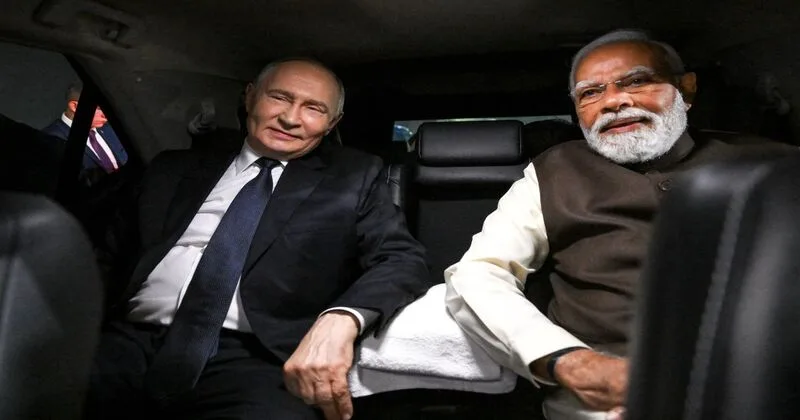
India witnessed a major geopolitical moment when Russian PresidentmVladimir Putin, visited New Delhi on December 4-5, 2025, his first in four years. The meeting marked the 23rd yearly talk between both nations, but felt deeper than usual, it showed how two old allies are quietly shifting gears together. While Western pressure grows, alliances shift around the globe, yet economic times feel shaky at best. Still, this event made one thing obvious: despite world chaos, India and Russia stand firm side by side. Their bond? Rooted not in words, but steady trust and quiet commitment through changing tides. At the end of the 28-hour trip, President Droupadi Murmu hosted him for a banquet as well. PM Modi called the India-Russia relationship steady like a “pole star (dhruva tara)”. The outcome of the Modi-Putin summit has been fruitful to say the least.
Despite the turmoil in the world, diplomacy prevailed
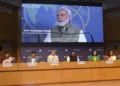
Prime Minister Modi with his signature display of friendship welcomed Putin at the airport with a tight warm hug, which opened the summit with a sense of bonhomie. This very gesture also points out that the foreign policy of India rests on amiable partnership, historical co-operation and strategic independence, not to mention external influence. This marks the tenth occasion when Putin has come to India and in contrast, Modi has only visited Russia seven times. The unbroken and very high-level interactions, which began with annual summits in 2000 and have now turned into a tradition, are an extraordinary example of diplomatic stability in the world today.
The royal reception of Putin at Rashtrapati Bhavan, along with a 21-gun salute, was more than just a show of the way. It was an act of symbolism. While the major part of the West is engaged in isolating Russia, the way India treated Putin was a clear signal of its intention not to succumb to one-sided pressure. PM Modi’s words, “India is not neutral, it stands on the side of peace”, stood noteworthy. The very first, strongest and loudest reaffirmation of the “Special and Privileged Strategic Partnership” idea, which was initially formalised in 2010, and that these relations are “resilient to external pressure” was the main content of the mutual communiqué consisting of 70 paragraphs and coming from the talks.
Defence: From buyer, seller to co-development
The summit marked a significant transition in India-Russia defence cooperation, which has been the foundation of mutual relations of the two countries since the Soviet period, indelibly imprinted in the past. India and Russia are moving away from just buying platforms and toward joint research, co-development, and co-production of state-of-the-art defence systems. The joint statement made a clear reference to the production of spare parts and components for equipment of Russian origin in India, with the possibility of exports to friendly countries later on.
India proved the operational capability of Russian systems through real-time combats like Operation Sindoor. The Su-30MKI and BrahMos combined with S-400 missiles could bring a seismic change in the game. This tangible confirmation is thereby a resource for fostering further cooperation. Though announcements of the Su-57 stealth fighter or additional S-400 regiments were not made, officials have spoken about these systems and that India is looking for technology transfer agreements that are compatible with its “Make in India” initiative.
The move towards spare parts localisation is an attempt to deal with the age-old problem of supply chain reliability, which is especially significant considering that 60-70 per cent of India’s military hardware is of Russian origin. By setting up joint ventures and maintenance, repair and overhaul(MRO) facilities in India, the country will not only strengthen its operational readiness but also cut down on the need for dependency.
Intelligence and counter-terrorism: Shared concerns
The mention in the combined statement of the tragic terrorist attacks in Pahalgam, Jammu and Kashmir and at Moscow’s Crocus City Hall was the main point of concern of the common security issues that these two countries share. They have pledged to each other to combat terrorism in every aspect, especially in cross-border terror, terror financing and safe havens.
One of the most notable agreements by the two governments was the decision to combine efforts in fighting the online radicalisation of extremists and the use of UAVs by them. This is a clear acknowledgement that the threats to security of the 21st century are beyond the traditional limits and they need a response from different countries working together. This cooperation, which is a crucial component of the bilateral relationship, they do it most of the time in silence and away from the eyes of the public.
The economic rebalancing Beyond oil
The most significant economic problem is a large imbalance in trade. The bilateral trade is around $65 billion, where India’s exports to Russia is just $4.9 billion, and imports, mostly oil, are close to $64 billion. The new goal of $100 billion by 2030 is very ambitious, but it may be possible if this imbalance is dealt with.
Russia is willing to import more Indian goods such as food products, seafood, pharmaceuticals, engineering goods and digital technology services. The Indian embassy in Moscow has pointed out that India could export an additional $8 billion in goods to Russia, thus almost tripling the current export volume, in areas where India already has the capacity for manufacturing but has little market presence in Russia.
Adopting the “Programme 2030” for economic cooperation is a step towards diversification. Both countries agreed on bilateral settlements in national currencies (rupee, ruble) and the possibility of central bank digital currency (CBDC) interoperability. These mechanisms aim to avoid Western sanctions and dollar dependency, even though they also show that it is a practical move due to the fact that Russia is disconnected from SWIFT and Indian banks are cautious of secondary sanctions; thus, alternative payment systems are necessary for trade continuity.
Energy security: A strategic pillar
Nearly 40 per cent of India’s crude oil imports are from Russia, and Putin promised “uninterrupted fuel supplies” to be able to meet India’s ever-increasing energy needs. Besides oil, cooperation is extended to LNG, coal and civil nuclear energy. The nuclear power plant at Kudankulam, which has two units in operation and four more being built, is a good example of long-term collaboration that has been successful. A joint statement made the announcement about the plans for a second nuclear site, with India promising to expedite the land allocation as part of the target of 100GW of nuclear capacity by 2047.
Another area of fertiliser supply that is a must is the one where Russia provides 51% of India’s DAP, more than 80 per cent of NPK fertilisers and over 16 per cent of urea requirements. India, facing fertiliser shortages due to supply disruptions from China, Turkey and Canada, finds Russian supplies to be of strategic importance for food security. The pact to set up joint venture fertiliser plants in India will be instrumental in cutting the country’s import dependency while at the same time stabilising rural livelihoods.
Connectivity and the arctic: New frontiers
For three strategic corridors, the focus was brought back once again: the International North South Transport Corridor (INSTC), the Chennai-Vladivostok Eastern Maritime Corridor and the Northern Sea Route (NSR). The INSTC, which can reduce the shipping time from 40 to 20-25 days as per the Suez Canal route, is seeing the cargo volume growth between 30 and 40 per cent on a yearly basis. By 2028, the completion of the Rasht, Astara railway stretch in Iran will be a major factor in connectivity enhancement.
The summit ushered the Reciprocal Exchange of Logistical Support(RELOS) pact, which will enable mutual access to military bases, logistics and support, expanding cooperation in operations, exercises, Arctic access, humanitarian missions and strategic defence coordination.
The Arctic aspect is pretty fascinating. Russia is welcoming India to the Arctic and as a part of it, is training Indian personnel in polar navigation for shipping in polar waters. With 13 per cent of the world’s oil with the highest likelihood of being undiscovered and 30 per cent of the gas also undiscovered, the Arctic, in this case, stands for both energy security and being strategically placed. As China is portraying itself as a near-Arctic state, India’s deepening engagement is a way of ensuring that it still has influence in this new geopolitical theatre.
People-to-People ties: Beyond governments
This pact is a win-win situation for both Russia and India, as it helps Moscow to alleviate its labour shortages with the “The Labour Mobility Agreement”. It simultaneously creates opportunities in the Russian labour market in various areas, like construction, engineering and the manufacturing sector, for Indians. Besides, India launched a 30 day free e-tourist visa for Russians to encourage tourism and cultural exchange between the two countries. With new Indian consulates in Yekaterinburg and Kazan, the diplomatic presence is going to be more powerful and the local engagement will be deepened.
They are not “seemingly” mundane measures; they are the “essential” ones for sustainable partnerships. Cultural understanding, educational exchanges and human contacts are the main drivers of the continued cooperation hence they form the basis of it and go beyond government-to-government relations.
Navigating external pressure with dignity
The “elephant in the room” was the Western pressure, especially US President Trump’s imposition of a 50 per cent tariff on Indian goods as a “punishment” for Russian oil purchases, which he considered a “punishment”. The joint statement’s emphasis on multilateral institutions, ranging from biodiversity conventions to the WTO, was an indirect rejection of unilateralism. Both countries, due to their common concern over militarization, teamed up to advocate for a legally binding space treaty to prevent the arms race in space.
India’s stance is a principled, pragmatic one; that means she has not breached any international sanctions, is still promoting the peaceful resolution of the Ukraine conflict and thinks that her energy purchases are commercially driven decisions by private companies. Modi also reiterated that “this is not the era of war”, but he didn’t agree to give up strategic interests under pressure.
A partnership for the future
The relationship between India and Russia continues to be strong, not due to a sentimental revival of the Soviet times, but because it is very much relevant to the present-day strategic interests. Russia is a provider of defence for India, a source of energy and a diplomatic ally on global issues like UN reform and counter, terrorism. On the other hand, India is a big market for Russia, a partner for technological collaboration and a source of geopolitical equilibrium to counterbalance too much dependence on China.
The summit joint statement description of this as a “time-tested partnership anchored in trust and mutual respect” captures its essence perfectly. Over 75 years, through the Cold War’s ideological rigidity, the unipolar moment’s triumphalism and today’s multipolar flux, this relationship has demonstrated remarkable adaptability. It is neither slavish alignment nor fair-weather friendship, but a mature strategic partnership between two civilisational states that understand their own interests and pursue them with dignity.
In a world that is becoming more and more multipolar, India’s strategy of keeping strong ties with countries on both sides of the geopolitical divide, such as Washington and Moscow, Tokyo and Tehran, should not be interpreted as a flaw, but rather as a major strength. The latest summit between New Delhi an Moscow was an affirmation of the India-Russia relations being a “guiding star”, as PM Modi put it: like a lighthouse, it was constant and necessary in times of storm.





Comments