






Hindu civilisation, one of the world’s oldest sanskritik lineages, today spans continents with a global population exceeding 1.2 billion people. Hindus constitute the third-largest religious community and maintain thriving diasporas across the United States, Canada, the United Kingdom, Australia, Africa, Southeast Asia,
and the Caribbean.
While Bharat is home to the largest Hindu population, significant communities live in Nepal, Bangladesh, Pakistan, Sri Lanka, Malaysia, Myanmar, Indonesia, Fiji, Mauritius, South Africa, Trinidad & Tobago, Suriname, and other regions. Their presence reflects civilisational continuity, social harmony, and a commitment to
peaceful coexistence.
Across these regions, the Hindu diaspora is recognised for exceptional educational and professional achievements. In the United States, more than 77 per cent of Hindus hold a Bachelor’s degree or higher, a figure far exceeding the national average. This demonstrates a deep emphasis on scholarship and merit.
In the United Kingdom, Hindus have some of the lowest unemployment rates among all religious groups. In Canada, Australia, and New Zealand, they stand out in income levels, entrepreneurship, and representation in Science, Technology, Engineering and Mathematics (STEM) professions. These achievements underscore the community’s global contributions.

Despite these successes, Hindus remain one of the least represented communities in international human-rights forums. Their vulnerabilities are rarely discussed, and violations against Hindus seldom attract the attention of the United Nations or global civil-society bodies. This underrepresentation persists due to ideological biases, the stereotype that Hindus are universally prosperous, and geopolitical sensitivities in South Asia.
Alarming Demographic Changes
This imbalance is most evident in Pakistan and Bangladesh. In Pakistan, the Hindu population has fallen from nearly 12–15 per cent at Independence to barely 1.5 per cent today. Reports by the Human Rights Commission of Pakistan and UN rapporteurs document forced conversions, temple attacks, abductions of Hindu girls, blasphemy charges, and seizure of community property.
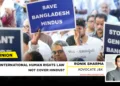
In Bangladesh, Hindus once formed nearly 30 per cent of the population. The figure has now dropped below eight per cent. Human-rights bodies record recurring attacks on Durga puja pandals, political violence, targeted killings, land confiscation, and cycles of intimidation that encourage migration. These long-standing patterns have never resulted in meaningful international scrutiny.
Afghanistan presents an even more extreme case. In the 1970s, nearly 70,000 Hindus and Sikhs lived there. Today, the Hindu population has effectively reduced to zero. Civil war, Taliban extremism, kidnappings, property confiscation, and systematic intimidation forced them either to flee or abandon their identity. The demographic disappearance of an entire religious community has attracted little global attention.
The Hindu refugee crisis in Bhutan also remains largely forgotten. More than 100,000 Lhotshampa Hindus of Nepali origin were expelled in the 1990s after being declared illegal immigrants. They were stripped of citizenship and pushed into refugee camps in Nepal. Although many were resettled through the UNHCR programmes, Bhutan has not restored their rights or permitted return.
Sri Lanka’s civil conflict highlights another dimension. Nearly 90 per cent of Sri Lankan Tamils are Hindus, and the community suffered mass displacement, disappearances, and erosion of cultural rights during the war. Yet their
Hindu identity finds little mention in global human-rights discourse.
Nepal’s transformation reinforces the vulnerability of Hindu identity. It was the world’s only Hindu nation until sustained Maoist and Communist pressure dismantled its Hindu constitutional character. No Muslim, Christian, or Buddhist nation has undergone such externally influenced constitutional re-engineering. Nepal’s experience shows that Hindu identity, even at a national level, can be politically targeted without eliciting global concern.
Malaysia reflects how institutional frameworks can quietly undermine minority rights. Century-old mandirs have been demolished under land-regularisation claims. The “Everest” Murthy case exposed difficulties faced by Hindus asserting religious identity. The prolonged legal struggle of Indira Gandhi, whose children were unilaterally converted to Islam, revealed systemic bias. The Bumiputera policy grants economic and educational privileges exclusively to Muslims, leaving Hindus at a structural disadvantage.
In Thailand, despite a rich legacy of Bharatiya sanskriti, the Hindu population has steadily declined. Assimilation pressures, lack of cultural protection, and minimal political representation have reduced the community to an almost invisible demographic, despite continued ritual significance in state ceremonies.
Across Africa, particularly Mauritius, Kenya, Uganda, Tanzania, and South Africa, Hindus are spearheading in business, medicine, and trade. Despite these contributions, inequities in landholding and access to financial resources persist. Historical patterns of nationalisation and property seizure continue to impact Hindu
communities in East Africa.
Existential Threat from all sides
In Western countries, new threats have emerged. Anti-immigrant protests in the UK, Canada, and Australia increasingly target Bharatiyas and Hindus. The Leicester violence of 2022 revealed growing hostility toward Hindu youth and businesses. In Canada, mandirs have been vandalised under the pretext of geopolitical activism, and diaspora leaders have faced intimidation. In Australia, extremist groups have defaced mandirs, reflecting an increasingly hostile environment.
Within Bharat itself, Hindus face localised challenges. Violence in Kashmir drove out an entire community of Kashmiri Pandits. In Bengal and Kerala, political and ideological violence has claimed Hindu lives. In Nagaland and parts of the Northeast, militant movements have displaced Hindu communities and undermined sanskritik identity.
Discrimination in Religious Institutions
Another unique internal challenge faced by Hindus in Bharat is the operation of the Hindu Religious and Charitable Endowments Act, which allow State Governments to control Hindu mandirs and utilise temple revenues for secular activities. Muslim and Christian religious institutions are exempt from such State control. This creates an unequal regulatory environment in which only Hindu institutions are deprived of autonomy, financial independence, and managerial freedom.
Apathy Towards Hindus
This asymmetry has profound consequences. Mandir funds that were historically meant for sanskritik preservation, community service, and religious education are often diverted to unrelated secular expenditures. Hindu priests, traditional temple scholars, and cultural practitioners receive limited support, weakening institutional continuity. No parallel statutory framework exists for mosques or churches, illustrating a uniquely discriminatory model.
Cultural deprivation is also reflected in the marginalisation of Sanskrit in Bharat, a language revered as dev bhasha. Despite being the language of Hindu scriptures, rituals, law codes, and philosophical texts, Sanskrit receives minimal institutional support in modern education. As a result, more than 99 per cent of Hindus cannot read or understand their primary scriptures in their original form. This disconnect has weakened sanskritik confidence, produced interpretational dependency, and separated communities from their textual heritage.
International human-rights instruments such as the Universal Declaration of Human Rights, ICCPR, ICESCR, and the UN Minority Rights Declaration guarantee equality, non-discrimination, cultural freedom, and religious liberty. Yet violations against Hindus receive little institutional follow-up. No UN inquiry has been conducted on the disappearance of Hindus from Afghanistan, Pakistan, or Bangladesh. No global commission has studied the demographic collapse of Hindus in conflict regions.
Temple attacks, forced conversions, refugee crises, and cultural erasures rarely appear in global narratives. This silence reflects a structural gap in global civil-rights enforcement. The Hindu experience remains marginalised due to geopolitical sensitivities, ideological bias, and a lack of unified global Hindu advocacy.
Human Rights Day must therefore become the beginning of a global Hindu human-rights movement. Hindu organisations should develop a coordinated international network capable of documenting violations, training activists in human-rights law, engaging with global institutions, and preparing annual reports. Temples, cultural bodies, student organisations, and community groups across the world must act as centres of rights-based advocacy.
A civilisation that has contributed immeasurably to global knowledge, spirituality, and cultural harmony cannot afford to remain invisible in the rights discourse. Hindu suffering—from Afghanistan to Malaysia, from Pakistan to Western democracies, and even within Bharat’s institutional frameworks—must finally be acknowledged.
International Human Rights Day should mark a turning point. It is time for Hindus worldwide to consolidate, organise, and assert their rightful place within the global human-rights framework so that Hindu human rights are recognised, respected, and protected with the seriousness they deserve.









Comments