





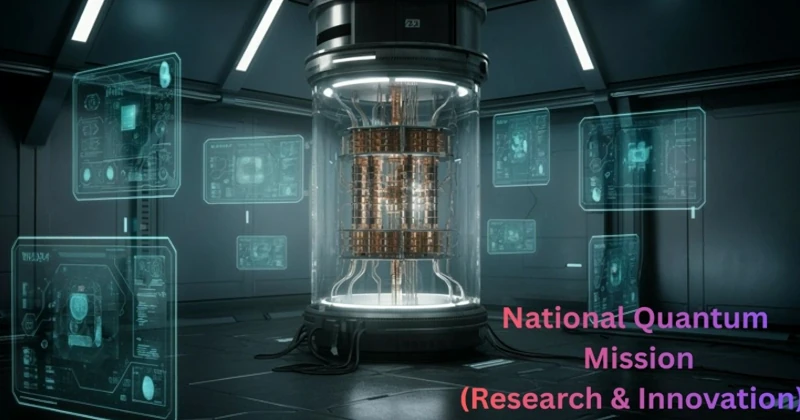
A transformative National Vision that has driven technological growth in India and the National Quantum Mission is the next decisive step in that journey. It has been implemented with a budget of Rs 6003.65 crore spread over eight years and aims at building a complete quantum ecosystem, thus making India scientifically stronger, economically powerful and strategically secure. The focus is on four broad areas of quantum computing, quantum communication, quantum sensing & metrology and quantum material devices. This Mission will support research and development, facilitates the emergence of advanced manufacturing, providing direct support to startups and MSME through skill development programs across the country. Through the combination of these efforts, the NQM attempts to convert the scientific potential of the country into globally competitive technologies, new avenues for employment, innovation and long term economic growth. It seeks to ensure that India is not only a participant in the quantum revolution but is in a position to shape and lead this rapidly evolving sector with increasing global stakes.
Four Thematic Hubs and their National Impact
To create a structured and efficient ecosystem, NQM has established four Thematic Hubs (T-Hubs) each registered as a Section-8 company and operated by a leading scientific institution. These Hubs became operational in 2024–25 and together they brought 152 researchers from 43 institutions across 17 States and 2 Union Territories, reflecting the Mission’s national scale and inclusiveness.
The Quantum Computing Hub at IISc Bengaluru, led by the Foundation for QC Innovation that carries the responsibility of developing Indian indigenous quantum processors. It is tasked with delivering intermediate scale quantum computers of 20–50 physical qubits in 3 years, 50–100 qubits in 5 years and 50–1000 qubits in 8 years. The Quantum Communication Hub jointly hosted by IIT Madras and C-DoT and incorporated as the IITM CDOT Samgnya Technologies Foundation. It focuses on secure satellite based quantum communication over 2000 km, inter-city quantum key distribution networks over 2000 km using existing fibre infrastructure and long distance secure communication with global partners.
The Quantum Sensing and Metrology Hub at IIT Bombay, established as Qmet Tech Foundation is advancing ultra-sensitive sensing technologies, including magnetometers with 1 femto-Tesla/sqrt(Hz) sensitivity in atomic systems and nitrogen vacancy sensors with better than 1 pico-Tesla/sqrt(Hz) sensitivity, as well as gravity sensors with sensitivity better than 100 nano-meter/second² and atomic clocks achieving 10-19 fractional instability.
The Quantum Materials and Devices Hub at IIT Delhi, operating as QMD Foundation is dedicated for designing and synthesising advanced materials such as superconductors, novel semiconductor structures and topological materials essential for the fabrication of quantum devices for computing and communication. These four hubs form a coordinated architecture to accelerate India’s progress in quantum technologies and ensure continuity between research, development, manufacturing and deployment.
Ambitious National Projects for a Global Quantum Future
The inherent strength of NQM lies in its clearly articulated national deliverables, reflecting both global competitiveness and domestic priorities. The first major objective of the Mission is to realize scalable quantum computing systems within India, starting from machines in the 20–50 qubit range and then moving toward 50–1000 qubit architecture in eight years. It also aims at establishing secure satellite based quantum communication between ground stations over 2000 kilometres inside India and with partner nations, thus laying the foundation for next generation encryption and communication infrastructure. Another major objective is to develop an inter-city quantum key distribution network over 2000 km through wavelength division multiplexing integrated with the existing optical fibre networks.
This mission also proposes to create multi-node quantum networks with entanglement swapping capabilities, synchronized quantum repeaters and high performance quantum memories across 2–3 nodes. Besides these communication and computing objectives, NQM lays emphasis on ultra-precise quantum sensors and timing systems that improve scientific research, national security, geophysical exploration and satellite based communication. These technological objectives are an effort toward the development of quantum materials and device fabrication capacity inside the country, an important requirement for self reliance in quantum hardware. All these deliverables will place India in that small group of countries pursuing end-to-end quantum capability.
Funding Footprint Spread Across the Nation
The funding pattern of the National Quantum Mission reflects a broad national ecosystem, with support reaching major research and academic institutions across India. Under the Quantum Communication Hub, a sanctioned Rs 614.31 crore is divided between a number of centres such as IIT Tirupati, IIT Patna, IIT Delhi, CDAC Bangalore, IISc Bangalore, Raman Research Institute and IIT Hyderabad. By November 2025 this Hub received Rs 5.16 crore in FY 2024–25 and Rs 101.28 crore in FY 2025–26.
With a sanctioned Rs 653.13 crore, the Quantum Computing Hub will support institutions like IIT Guwahati, IIT Delhi, IISc Bangalore, IIT Bombay, and TIFR Mumbai, with releases of Rs 3.05 crore in FY 2024-25 and Rs 172.70 crore in FY 2025-26.
Quantum Materials & Devices Hub and the Quantum Sensing & Metrology Hub have sanctioned amounts of Rs 312.79 crore and Rs 589.40 crore, respectively. This Mission represents a total sanctioned outlay of Rs 2169.62 crore, underlining its truly national reach. Expanding Access through Teaching Labs and Proposal Calls
A distinctive feature of the NQM is its attempt to democratise access to quantum education and enhance the homegrown talent base. To track skill development and laboratory training, the Mission recently issued two all India Calls for Proposals. The first call invited proposals from institutions for establishing teaching laboratories in quantum technologies, this call has received 433 proposals, including 134 from Andhra Pradesh alone. A second call was issued for inviting proposals for establishing a Technical Group in Quantum Algorithms, this call attracted 373 responses, of which alone 84 were from Andhra Pradesh. These numbers are a reflection of the rising national interest in quantum science, as well as the intent of universities and technical institutions to upgrade their laboratory infrastructure and leap into the emerging quantum ecosystem. Proposals are under evaluation by expert committees and the selected institutions will be supported with infrastructure, equipment, training and academic programme development. This initiative demonstrates the resolve of the Mission to create a decentralized and inclusive quantum education pipeline that reaches students and researchers across India.
Strategic Significance and the Way Forward
The National Quantum Mission is a signal of Indian aspiration towards digital sovereignty, secure communication networks and leadership in future scientific frontiers. Quantum technologies have implications for cybersecurity, finance, national defense, deep sciences, high-precision navigation and global communications. NQM integrates elements such as coordinated research hubs, nationwide participation, advanced fabrication capabilities and targeted support for startups into one grand strategy so that India will build an integrated ecosystem rather than isolated pockets of expertise.
The structure of the Mission encourages strong industry-academia linkage, international collaboration and a continuous pipeline of skilled professionals who can sustain long-term innovation. As global competition in quantum technologies intensifies, India’s structured progress guided by precise deliverables, strong institutional networks and national level funding, places it in a position to shape the technological landscape of the coming decades. NQM is building both capability and confidence of India, the capability to produce world class quantum technologies and the confidence to lead in a world where scientific advantage is increasingly being translated into economic and strategic strength.















Comments