





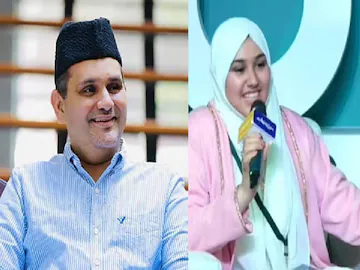
A public call by Fathima Nargese, daughter of Panakkad Munavarali Shihab Thangal, national secretary of the Indian Union Muslim League (IUML), for women’s entry into mosques sparked an intense debate across Kerala’s Muslim community and drew sharp reactions from conservative groups.
Speaking at Hortus, a programme organised by Malayala Manorama in Kochi on December 6, Fathima argued that the restriction on women entering mosques has no basis in religious injunctions. Highlighting that women participate fully in Haj rituals, she questioned the logic of barring them from local mosques.
“Women take part in all the rituals of Haj. Denying them entry to mosques is not fair. This tradition was created by some people, not by religious rules. It should change and it will change. It will be a revolution,” she said. A video clip of her remarks went viral on social media, intensifying the conversation.
However, her father distanced himself; calls daughter’s stand ‘not aligned with community consensus’
Following backlash from conservative Muslim circles, her father Munavarali Shihab Thangal issued a public clarification. He emphasised that Fathima’s view does not reflect the stance of the mainstream Sunni community in Kerala and is inconsistent with resolutions adopted by recognised Muslim scholars.
Calling it the “thoughtless and impromptu reaction of a sixteen-year-old”, he attributed her remarks to insufficient religious study. He added that he was “correcting” her understanding of a subject defined by scholars with deep theological expertise, and that he took responsibility for issuing the clarification.
Munavarali, a prominent figure from the influential Panakkad family, occupies a central position in the IUML, which traditionally intertwines religious authority and political leadership.
Observers say the episode signals a gradual generational shift among young Muslims, particularly girls in Kerala, many of whom increasingly question long-standing Islamic customs related to gender and religious practice. The argument for women’s access to mosques has resurfaced repeatedly in Kerala, but Fathima’s statement coming from within the IUML’s first family has renewed the debate with added force.







Comments