





For decades after Independence, India’s defence preparedness rested on a structural contradiction. The armed forces were large, professional and constantly engaged in safeguarding the nation, yet the technological backbone of this military strength was overwhelmingly foreign. Well into the mid-1990s, nearly 70 per cent of India’s defence equipment came from abroad—largely from the Soviet Union/Russia and supplemented by Israeli and Western suppliers. While this model delivered operational capability, it did not deliver strategic control. India repeatedly witnessed how external shocks could jeopardise its preparedness: the logistical constraints during the 1965 and 1971 wars, the challenges faced during Operation Vijay in Kargil and more recently the worldwide shortage of spares triggered by the Russia–Ukraine conflict. These episodes highlighted a hard truth—a nation relying heavily on foreign platforms can never achieve true strategic autonomy. Ammunition, upgrades and even basic maintenance could be delayed or denied when geopolitics took a turn.
Tougher security environment and the case for Atmanirbharta
India’s contemporary security environment has only amplified the urgency of self-reliance. China’s rapid military expansion along the northern borders and across the Indo-Pacific, Pakistan’s continued use of terrorism as statecraft and the rise of new conflict domains—cyber, space, electronic warfare and unmanned systems—have made assured access to advanced technologies indispensable. Global disruptions have underlined the risk of dependence. The wars in Ukraine and Gaza, the semiconductor shortages and sudden supply chain collapses all demonstrated that import-dependent militaries risk paralysis in crises. When sanctions or export controls are imposed, nations without indigenous capability lose critical time and flexibility. In this context, Atmanirbharta in defence has shifted from a policy choice to a national security necessity.
Political vision: From dependence to strategic autonomy
Prime Minister Narendra Modi has repeatedly framed self-reliance in defence as central to India’s emergence as a secure, confident and developed nation by 2047. His emphasis on India “attaining Atmanirbharta in defence and emerging as a global manufacturing hub” reflects a strategic shift—the desire not just to buy weapons, but to design, develop and sustain them indigenously. Highlighting successful operations such as Operation Sindoor, he has stressed that indigenous platforms, once validated in combat, strengthen deterrence, build national confidence and establish India as a dependable supplier. This is the transformation India seeks: from a buyer on foreign suppliers’ terms to a producer operating on its own strategic terms.
Legacy Bottlenecks: Slow procurement and a shallow industrial base
The move toward self-reliance began with confronting structural weaknesses. Before 2014, India’s procurement framework was often slow, fragmented and vulnerable to procedural delays. Critical needs remained unaddressed for years. At the same time, the dominance of defence PSUs, limited private participation and insufficient technology access prevented the growth of a broad industrial ecosystem. Defence exports, at only ₹686 crore in 2013–14, were negligible compared to India’s import bills. The imbalance between domestic capability and foreign dependence was stark—an unsustainable model for a nation aspiring for strategic autonomy.
Institutional overhaul
A major departure came with structural reforms. The creation of the Department of Military Affairs under the Chief of Defence Staff unified responsibility for modernisation, joint planning and procurement. For the first time, the three services—Army, Navy and Air Force—worked within an integrated decision framework. Simultaneously, the Defence Acquisition Council (DAC) was strengthened to streamline approvals and prioritise indigenous options. This has significantly reduced the long-standing procedural inertia that earlier delayed acquisitions and created capability gaps.
Budgetary support and clear domestic bias
Reforms were backed by financial commitment. The defence budget increased from ₹2.53 lakh crore in 2013–14 to nearly ₹6.81 lakh crore in 2025–26. Crucially, close to 75% of the capital procurement budget has been reserved for domestic industry in recent years. This predictable demand has encouraged both public and private sector companies to invest in new capacities, technologies and partnerships. It is this stable pipeline of orders that has catalysed India’s defence industrial transformation.
Production and export surge
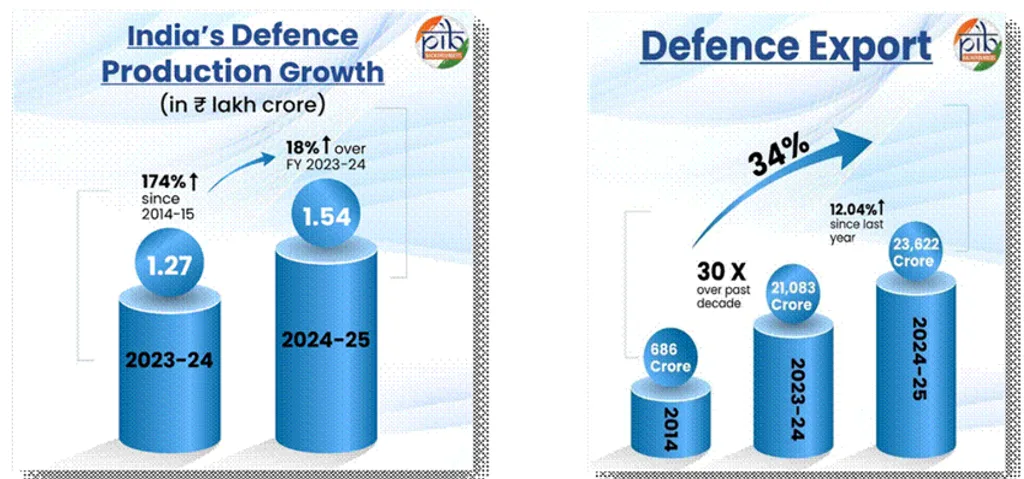
India’s manufacturing capability has expanded dramatically. Indigenous defence production rose from ₹46,000 crore in 2014–15 to about ₹1.27 lakh crore in 2023–24, and further to nearly ₹1.50 lakh crore in 2024–25—a remarkable 174 per cent increase in a decade. Exports, too, have surged—from under ₹1,000 crore in 2013–14 to ₹21,083 crore in 2023–24, and to ₹23,622 crore in 2024–25. India now exports systems to more than 90 countries, including the US, France and Armenia. The government’s target of ₹3 lakh crore in production and ₹50,000 crore in exports by 2029 reflects confidence in this upward trajectory.
The policy architecture
These gains rest on a well-designed policy foundation. Make in India (2014) repositioned defence manufacturing as a core national priority, opening the sector to private companies, simplifying licensing and encouraging domestic value addition. The Defence Production and Export Promotion Policy (DPEPP) 2020 provided a clear roadmap—strengthening R&D, supporting MSMEs, incentivising innovation and promoting exports. Importantly, it shifted India from mere import substitution to the pursuit of technological leadership and global competitiveness.
Procurement reform
The Defence Acquisition Procedure (DAP) 2020 revolutionised procurement logic by placing Buy (Indian-IDDM)—Indigenously Designed, Developed and Manufactured—at the top of all priority categories. Services must now first consider Indian-designed systems before foreign ones. Complementing this, the Defence Procurement Manual (DPM) 2025 modernised revenue procurement, standardising procedures and enabling faster, transparent acquisition. Together, these reforms created a unified procurement architecture aligned with operational readiness and Atmanirbharta.
Positive lists and import embargoes
A landmark reform has been the introduction of positive indigenisation lists. Since 2020, more than 400 major items and over 2,500 sub-systems have been placed under import embargo. These time-bound restrictions have created guaranteed demand for domestic companies and strengthened India’s industrial resilience by reducing foreign-dependency in essential equipment.
DRDO, DPSUs and the new public sector role
In parallel, public-sector reforms have reshaped India’s defence ecosystem. The DRDO has emerged as a catalyst, not just a developer, fostering industry–academia collaboration through the Technology Development Fund and Centres of Excellence. The restructuring of the Ordnance Factory Board into seven modern DPSUs has increased autonomy and accountability. These new entities have begun to report significant exports, demonstrating improved efficiency and competitiveness.
Private sector and MSMEs: Broadening the industrial base
One of the most profound shifts has been the rise of the private sector and MSMEs. With nearly 16,000 MSMEs feeding into defence supply chains, India is building a broad, resilient industrial base. Companies, large and small, are now active players in aerospace, drones, radars, armoured vehicles and electronics. Platforms such as SRIJAN and iDEX have opened doors for start-ups and innovators to enter defence production, generating indigenous solutions for complex military challenges. These reforms have expanded defence from a PSU-dominated sector to a dynamic, multi-player ecosystem.
Indigenous platforms: The expanding “Made in India” arsenal
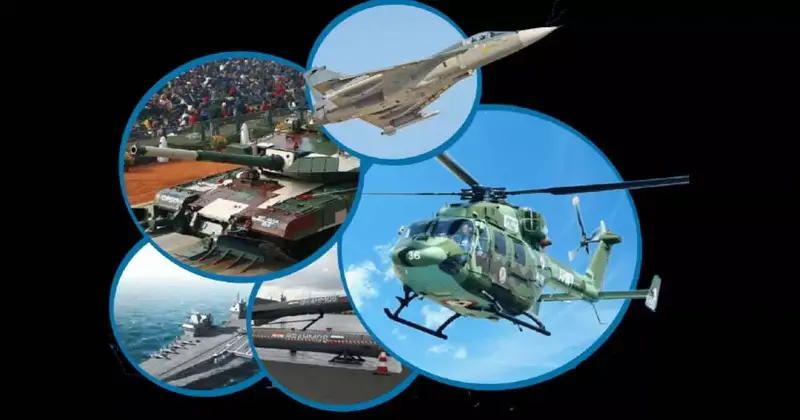
The true measure of Atmanirbharta lies in the platforms now entering service:
- Dhanush and ATAGS artillery systems
- Pinaka multi-barrel rocket launche
- Akash and BrahMos missile systems
- LCA Tejas, ALH Dhruv and LCH Prachand
- Advanced destroyers, frigates, patrol vessels
- Indian-built submarine classes
The Defence Acquisition Council has further accelerated indigenisation by approving major acquisitions under Buy (Indian-IDDM), deepening supply chains and boosting confidence across industry.
Strategic payoffs: Autonomy, economy and diplomacy
Atmanirbharta offers multi-dimensional dividends. Strategically, domestic manufacturing strengthens operational readiness and insulates the forces from global supply shocks. Politically, it enhances India’s bargaining power and reduces vulnerability to sanctions or external pressure. Economically, a thriving defence industry creates high-skill jobs, supports MSMEs, stimulates R&D and contributes to national growth. Diplomatically, India’s ability to supply defence equipment—especially to the Global South—reinforces its role as a responsible, reliable security partner.
Challenges
Despite major progress, India still faces capability gaps in:
- High-performance aircraft engines
- Advanced radar and EW systems
- Submarine propulsion
- Long-range ISR technologies
India’s R&D expenditure, at around 0.7 per cent of GDP, remains lower than major powers. Enhancing research, encouraging public-private partnerships and accepting calculated technological risk will be crucial. Additionally, global competitiveness requires improvements in quality, programme management, testing, certification and after-sales support.
Defence corridors and regional industrial hubs
India’s defence industrial geography is transforming. The Uttar Pradesh and Tamil Nadu defence corridors, alongside aerospace and naval clusters in Karnataka, Maharashtra, Gujarat and Haryana, are emerging as powerful growth centres. These hubs have attracted thousands of crores in investment and are poised to unlock far greater industrial potential.
Completing the journey to the producer’s line
India’s defence transformation is reshaping its global strategic posture. The era of Indian delegations travelling abroad to negotiate for spares and technology is giving way to another—one in which other nations seek Indian-made systems, from radars and UAVs to missiles and naval vessels. Atmanirbhar Bharat is not isolationism. It represents confident integration with global supply chains while building domestic strength. If India continues expanding its technological base, bridging capability gaps and sustaining reforms, the next decade could see it achieve genuine strategic independence. The journey from buyer to producer’s line is well underway—and its successful culmination will define India’s security, autonomy and global influence in the twenty-first century.















Comments