India-Bhutan Strategic and Time-tested Partnership
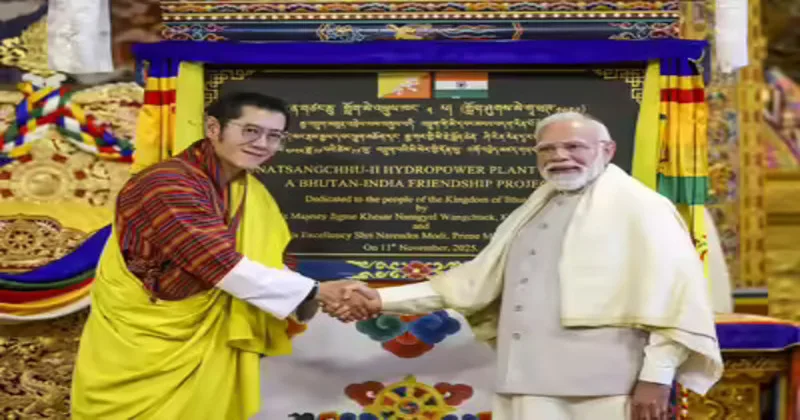
The visit of Prime Minister Narendra Modi to Bhutan on November 11 and 12 did not receive much media attention, because of the Delhi terror blast on November 10 and second phase of Bihar assembly elections on November 11. The visit of PM Modi to Bhutan was another significant step to strengthen our relations with a close neighbour that is also a buffer state between India and China.
PM Modi was invited by Jigme Khesar Namgyel Wangchuk, the King of Bhutan as the Guest of Honour to mark the 70th birth anniversary of the Fourth Druk Gyalpo on November 11. The fourth Gyalpo of Bhutan Jigme Singye Wangchuk is the father of the present king of Bhutan, reigning the kingdom from 1972 to 2006. At the age of just 51 years, he handed over the baton to his son after overseeing transition of Bhutan from absolute monarchy to democratic constitutional monarchy. In the recent history, there are very few examples of such peaceful transition of power in a monarchy.
India and Bhutan share a special relationship based on the Treaty of Friendship and Cooperation, 2007 and the fourth king of Bhutan was the main architect of this treaty. It was therefore Prime Minister Modi joined the 70th birthday celebrations of the Fourth Druk Gyalpo. The present treaty has evolved into a dynamic partnership based on mutual trust, with close cooperation between the two nations spanning economic development, energy, technology, defence and security. PM Modi also shares warm personal relationship with the monarchy and PM of Bhutan. In fact, PM Tshering Tobgay of Bhutan has publicly stated that he considers PM Modi his elder brother and mentor.
Bhutan shares 699 km long border with India that runs along Sikkim, West Bengal, Assam and Arunachal Pradesh. It is a peaceful and friendly border and the only land access to Bhutan is through the border at Jaigaon(WB) on the Indian side and Phuentsholing on the Bhutan side. Both Indian and Bhutanese citizens have easy access to each other’s country through this land border. In fact, such a friendly border can be a role model for regional cooperation and smooth connectivity. Most of the trade between Bhutan and India also takes place through this border, with least paperwork and hassles.
PM Modi’s visit to Bhutan is also significant because China has been trying to woo Bhutan into its economic debt trap policy. It is to the credit of the Indian diplomacy that Bhutan has not allowed China to open an embassy in the capital Thimphu. China has cited border dispute with Bhutan. China has claim over Doklam Plateau in the western sector and Sakteng Wildlife Sanctuary in the eastern sector of Bhutan. China has built villages and infrastructure including roads in the vicinity of disputed areas of Bhutan. India has viewed the reported inroads by China towards Bhutan with concern.
China has been asserting through Doklam because of its proximity to the Siliguri Corridor, a narrow passage connecting India’s northeast to the rest of the country. It is important to recall the Doklam standoff between India and China in the year 2017 that lasted 75 days. Bhutan played a crucial role in allowing Indian troops to quickly enter through its territory to resist Chinese advance and ultimately push them back, thereby maintaining territorial integrity of Bhutan. By doing so, India once again neutralised Chinese attempts to dominate Siliguri Corridor.
Even during the latest visit of PM Modi to Bhutan, the two sides underlined the importance of improving cross border connectivity and enhancement of border infrastructure. The Immigration Check Post (ICP) at Darranga is functional since November 2024. Going a next step further, a Memorandum of Understanding (MoU) for establishing cross-border rail links at Gelephu-Kokrajhar and Samtse-Banarhat was further refined during the visit of PM Modi. India wants to ensure that such connectivity also serves the purpose of quick mobilisation during an operational scenario.
During my military career, I served in Indian Military Training Team (IMTRAT) located in Bhutan. I also had the good fortune of serving in all the four states that border Bhutan. With the ground knowledge, I can say with certainty that India has taken timely steps to defend itself from the Chinese threat to the Siliguri Corridor. The visit of PM Modi has further strengthened the time-tested diplomatic relations with its close partner Bhutan. The visit has served the dual strategic purpose of keeping Bhutan away from the Chinese influence in general and the Siliguri Corridor in particular. The people to people connect between India and Bhutan has continued to ensure warm friendship between the two nations.

Leave a Comment