





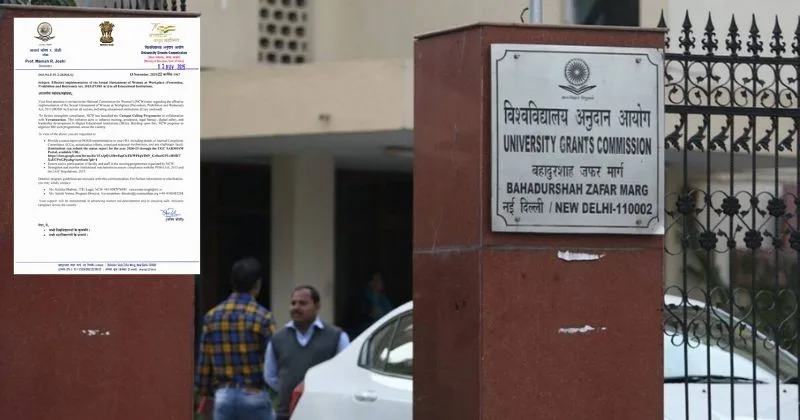
NEW DELHI: The University Grants Commission (UGC) has issued an important notice to all universities and higher education institutions in India, asking them to strictly follow the rules of the Sexual Harassment of Women at Workplace (Prevention, Prohibition and Redressal) Act, 2013 commonly known as the POSH Act. This circular, signed by UGC Secretary Prof. Manish R Joshi, shows the urgent need for institutions to foster a safe, inclusive, and gender-sensitive campus environment.
Background: A Step Toward Women Safety in Educational Institutions
The POSH Act, enacted in 2013, w as introduced to provide protection against sexual harassment at workplaces and to ensure redressal of complaints in a fair and timely manner. Educational institutions, being workplaces under the Act, are legally bound to adopt its provisions and maintain zero tolerance toward any form of sexual harassment.
Over the years, while many institutions have taken proactive steps to establish Internal Committees and conduct awareness programmes, instances of underreporting and lack of awareness have persisted. The UGC’s latest communication seeks to bridge these gaps and strengthen the implementation of the Act across all educational campuses in the country.
📢 Important Update for All Educational Institutions
Subject: Effective Implementation of the POSH Act, 2013
The University Grants Commission (UGC) has issued an important communication regarding the Sexual Harassment of Women at Workplace (Prevention, Prohibition and… pic.twitter.com/dzqiWza5mt
— UGC INDIA (@ugc_india) November 14, 2025
In its latest communication (D.O.No.F.91-2/2025(GS)), the UGC has drawn attention to the National Commission for Women’s (NCW) letter emphasizing strict enforcement of the POSH Act across all educational institutions. The NCW and Yuvamanthan have together started the Campus Calling Programme. It is an initiative aimed at promoting awareness, training, and leadership development related to gender equality and safety in higher education institutions.
Click here to download the complete notification on POSCH
This programme seeks to conduct around 800 awareness and training sessions across the country, ensuring that both students and faculty members are educated about their rights, responsibilities, and the redressal mechanisms available under the law.
Mandatory Actions for Institutions
The UGC has instructed all higher educational institutions (HEIs) to take immediate action to ensure compliance with the POSH Act, 2013. Institutions have been asked to submit a status report detailing their compliance efforts for the academic year 2024-25 through the UGC SAH-SHAKTI Portal. The report must include comprehensive details such as:
Formation and Functioning of Internal Complaints Committees (ICCs): Each institution must have a fully functional ICC as per the provisions of the Act. The ICC should be well-trained to handle complaints sensitively, ensuring confidentiality, fairness, and timely resolution.
Sensitization and Awareness Programmes: Regular awareness sessions, workshops, and gender sensitization programmes should be conducted for students, faculty, and staff. These sessions should educate participants about workplace boundaries, reporting mechanisms, and respect-based conduct.
Complaint Redressal Mechanism: Institutions are expected to outline clear procedures for lodging and investigating complaints of sexual harassment. The mechanism should ensure accessibility, transparency, and accountability at every level.
Reporting and Transparency: UGC has stressed that all cases must be addressed promptly, with appropriate action taken as per the law. Annual reports on complaints received and resolved must be maintained and submitted to the competent authorities.
Training of ICC Members: Institutions must ensure active participation of faculty and ICC members in training programmes organized by the NCW and Yuvamanthan under the Campus Calling initiative. This will help strengthen their capacity to deal with sensitive cases effectively.
The directive highlights that the implementation of the POSH Act is not merely a statutory requirement but a collective moral responsibility of all educational institutions. Universities and colleges play a crucial role in shaping young minds, and ensuring their safety and dignity is a cornerstone of inclusive education. Prof. Manish R. Joshi emphasized that higher educational institutions must go beyond compliance to create a culture of mutual respect and gender sensitivity. He urged all universities to strengthen internal systems and promote transparency in dealing with complaints.
“Your support will be instrumental in advancing women-led development and in ensuring safe, inclusive campuses across the country,” the circular notes.
The Campus Calling Programme, launched by NCW in collaboration with Yuvamanthan, focuses on five key areas i.e. gender sensitization, legal literacy, digital safety, leadership development, and awareness training. The programme empowers young women to identify and report inappropriate behaviour while encouraging men to be allies in promoting respectful workplaces.
By including students, faculty, and administrative staff, this programme promotes a culture of communication and education rather than fear or stigma. NCW plans to organize 800 such programmes in universities and colleges nationwide, marking a major step forward in the fight against sexual harassment.
Support and Contact Details
For assistance or clarification regarding the POSH compliance process, institutions can contact: Krutika Dhabhai, JTE (Legal), NCW: +91-9587976193, ramavatar.singh@nic.in; Sakshi Verma, Programme Director, Yuvamanthan: +91-9540483248, director@yuvamanthan.org
The UGC has assured continuous support to all institutions in ensuring that the Act is implemented effectively and that women’s safety is prioritised at every educational level.
With this new focus, the UGC wants campuses to be places that promote respect, equality, and fairness along with academic learning. It has asked institutions to regularly review their internal systems and share detailed reports on the results of their awareness programs.
If institutions do not follow these rules, they may face strict review, as the UGC has clearly stated that ensuring gender safety and equality is a must for every institution.
















Comments