





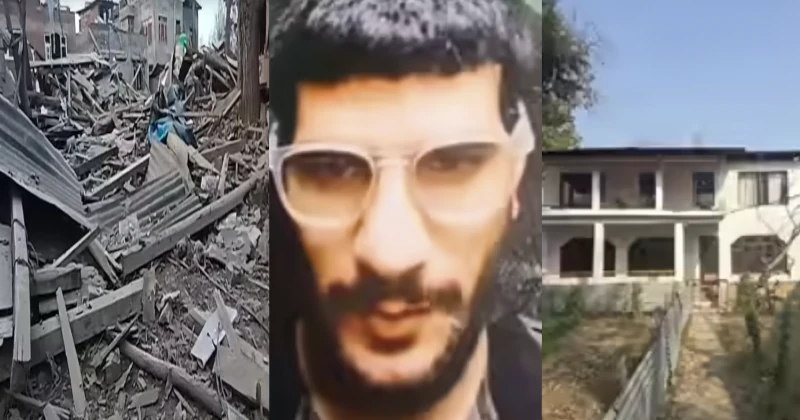
Security forces on November 14, carried out a controlled demolition of the Pulwama residence of Dr Umar-un-Nabi, the key suspect behind this week’s devastating Red Fort car-bomb explosion in Delhi that killed 13 people and injured over 20. The house, located in a densely populated neighbourhood of Pulwama, was destroyed using an improvised explosive device (IED) as part of the broader anti-terror probe a rare step that underscores the scale and complexity of the plot now emerging.
The demolition was executed during the intervening night of November 13 and November 14, following a detailed forensic sweep of the premises. According to officials, the Pulwama house had served as Umar’s primary operational hideout, storage site, and communication centre for the Delhi module.
This drastic action came after investigators conclusively matched DNA traces from the Red Fort blast site with samples taken from Umar’s mother, confirming that it was he who had been driving the explosive-laden Hyundai i20 that detonated near the historic monument on November 10.
Hours after the Red Fort bombing, J&K Police carried out intense overnight raids, arresting six individuals including three members of Umar’s family. Officials described Umar as a once academically promising young doctor who had, over the last two years, undergone a severe ideological drift toward hard-line Islamist extremism.
A senior investigator stated that the 28-year-old doctor became deeply embedded in radical circles after joining multiple encrypted messaging groups and foreign-controlled channels.
Investigators have now formally tied Umar to a terror module operating under the dual influence of Jaish-e-Mohammed (JeM) and Ansar Ghazwat-ul-Hind (AGuH) two Pakistan-backed organisations responsible for multiple attacks in India.
The most alarming revelation is the emergence of a foreign handler known as Ukasa, believed to be the primary coordinator between the Delhi-based cell, Pakistan-backed networks, and affiliated operatives in Kashmir.
According to officials, the conspiracy has roots stretching back to Turkey in 2022, where Umar and three associates lived in Ankara for several months. During this period, the group reportedly received training in covert operations, evading intelligence networks, and setting up decentralised terror cells.
“Ukasa guided them on establishing covert modules, managing funds without leaving digital traces, and migrating from mainstream apps to deep-encrypted networks,” an intelligence officer said.
The module relied heavily on a wide array of encrypted communication tools:
- Threema: The Switzerland-based encrypted app used for high-level coordination
- Signal: Where Umar created a small, secret group to manage operational logistics
- Session and Telegram: Initial meeting points before security risks prompted a platform shift
Investigators claim these apps were used to plan routes, select targets, coordinate funding, and divide responsibilities.
The group collected over Rs 26 lakh in cash, with Umar serving as the primary custodian. The money was funnelled into the procurement of bomb-making materials, mainly 26 quintals of NPK fertiliser, worth around Rs 3 lakh, purchased from suppliers in Gurugram, Nuh, and adjoining regions of Haryana.
NPK when mixed with other chemicals forms a powerful base for IED construction.
The scale of the conspiracy is now coming into sharper focus. Sources told PTI that around eight suspects were preparing to split into pairs and unleash coordinated blasts across four different Indian cities, indicating the Red Fort bombing may have been the opening strike in a larger terror blueprint.
Beyond Umar, two other Kashmiri doctors Dr Muzammil Ahmad Ganaie and Dr Shaheen Shahid — have been identified as core members of the module. Their arrests following the exposure of the Faridabad terror module, where authorities seized a staggering 2,900 kg of explosive material, provided early clues linking the Delhi blast to a wider operational chain.
The presence of highly educated professionals in the network has raised urgent questions about the radicalisation pipeline and the penetration of extremist groups into professional communities. The demolition of Umar’s Pulwama residence is symbolic of the terror ecosystem that investigators believe he helped create a safehouse used for:
- Storing chemical precursors
- Hosting covert meetings
- Communicating with handlers abroad
- Preparing escape routes
- Housing materials linked to multiple modules
Officials said the house had been structurally altered to hide contraband and facilitate clandestine movement. With the Red Fort blast exposing a cross-border, cyber-enabled terror network, agencies are now focusing on:
- Identifying sleeper operatives in Delhi, Kashmir, Haryana, and Uttar Pradesh
- Tracing fund movements through informal and crypto channels
- Mapping the module’s Turkish linkages
- Capturing remaining operatives tied to Ukasa
The investigation has already unearthed a sprawling network of ideological indoctrination, financial pipelines, encrypted communication hubs, and foreign support structures pointing to a new phase of hybrid terrorism leveraging digital anonymity and professional operatives.





Comments