





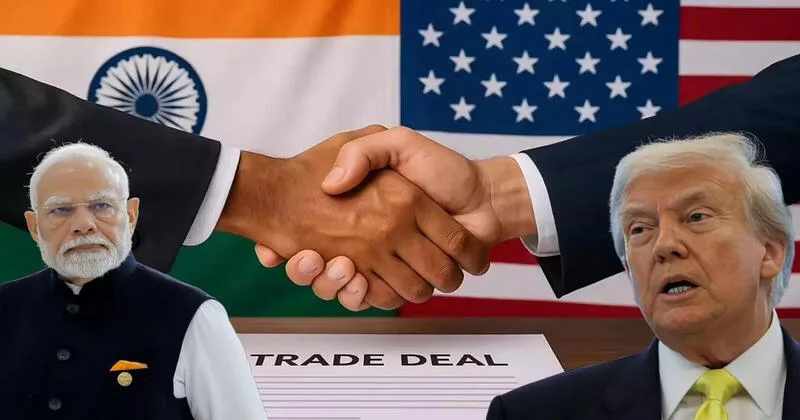
The long-anticipated trade agreement between India and the United States is edging closer to reality, with detailed trade proposals prepared by the Indian delegation formally handed over to the US administration. According to senior officials in New Delhi, the Indian side has completed all necessary consultations, and there is no need for further discussions. The final decision now rests with Washington.
The breakthrough comes amid positive signals from US President Donald Trump, who acknowledged that the tariffs imposed on Indian goods were excessively high and assured that they would soon be reduced. Trump, while speaking to reporters yesterday, noted that both sides were close to achieving a mutually beneficial deal. He remarked that although India had been displeased with the tariffs, relations would soon improve once the trade adjustments were made. India’s trade proposal, submitted to the US, has been designed to remain fully compliant with the World Trade Organisation’s (WTO) rules and guidelines. However, Union Commerce Minister Piyush Goyal reiterated that India would not compromise its national interests in the pursuit of any international trade agreement. He emphasised that the government would not undertake any steps that could harm the interests of the country’s farmers or its dairy industry.
Speaking at the Udyog Samagam 2025 conference of state commerce and industry ministers, Goyal highlighted ongoing efforts to expand market access for Indian products in new regions, including Russia. These initiatives, he said, were intended to strengthen key sectors such as agriculture, which have suffered significantly due to the high tariffs imposed by the United States. One of the most contentious issues in the negotiations has been Washington’s demand that India open its agricultural and dairy markets fully to American companies and eliminate tariffs on US products. The Indian negotiating team has firmly opposed these demands, citing the risk of destabilising domestic markets and reigniting farmer protests. According to government officials, the decision to protect the agriculture sector is rooted in the need to safeguard rural livelihoods and ensure food security.
Indian market optimism and sectoral gains
The optimism surrounding the India–US trade deal, coupled with the resolution of the US government shutdown and positive global market trends, has boosted investor sentiment in India. The stock markets are expected to continue their upward momentum this week. On Tuesday, the Sensex closed at 83,871 points, gaining 336 points or 0.40 per cent, while the Nifty advanced by 121 points or 0.47 per cent to reach 25,694. Early indicators from the GIFT Nifty, which jumped 143 points this morning, suggest that the Indian stock indices are poised to open with significant gains. The enthusiasm has been most visible in sectors expected to benefit directly from improved trade relations with the US.
Seafood and apparel export companies witnessed a strong rally yesterday, driven by expectations of lower US tariffs. Shares of seafood exporters such as Apex Frozen Foods and Avanti Feeds surged by up to 11 per cent, while apparel exporters, including Gokaldas Exports and Raymond Lifestyle, rose by nearly 5 per cent. Several major firms, including Tata Steel, Asian Paints, Ashok Leyland, Hindustan Aeronautics, Indraprastha Gas, IRCTC, Info Edge, SpiceJet, and Prestige Estates, are expected to release their quarterly results today. Meanwhile, Tata Power reported a marginal decline of 0.8 per cent in profit and a 1 per cent fall in revenue in its second-quarter results announced yesterday. In contrast, the Bombay Stock Exchange (BSE) reported a strong 61 per cent jump in profit and a 44.2 per cent increase in revenue. Rail Vikas Nigam Limited, however, posted a 19.7 per cent fall in profit despite a 5.5 per cent rise in revenue.
US shutdown nears resolution
In the United States, the Trump administration is on the verge of ending the 42-day government shutdown, which had disrupted federal operations and dampened economic sentiment. The Senate has passed a bill to reopen the government, and the measure is now awaiting approval from the House of Representatives. The resolution of the shutdown is expected to bring relief to financial markets and restore investor confidence.
However, US stock indices closed mixed on Tuesday, reflecting a cautious mood. While the end of the shutdown was a positive development, renewed selling pressure on technology stocks weighed on market performance. The decline followed an announcement by Japanese investment bank SoftBank that it had sold its entire stake in Nvidia, the world’s most valuable technology company. Following the news, SoftBank’s share price plunged by 10 per cent, triggering wider concerns in tech-heavy indices. In futures trading, the Dow Jones Industrial Average rose a marginal 0.01 per cent, while the S&P 500 and Nasdaq 100 futures gained less than 0.1 per cent. Asian markets, in contrast, showed modest but consistent gains. Japan’s Nikkei rose 0.25 per cent, Hong Kong’s Hang Seng advanced 0.75 per cent, and Australia’s ASX200 increased by 0.13 per cent. In Europe, the FTSE climbed 1.15 per cent, and Germany’s DAX added 0.53 per cent.
Currency and oil updates
The Indian rupee strengthened further on Tuesday, closing at 88.50 against the US dollar, up 23 paise from the previous day. The appreciation was supported by easing concerns over the US shutdown and growing optimism about the India–US trade deal. Gold prices remained largely stable, trading at around $4,133 per ounce, up by $19 in early morning trade. Analysts expect minimal fluctuation in domestic gold prices today. Crude oil markets, however, showed signs of volatility. West Texas Intermediate (WTI) crude slipped 0.26 per cent to $60.88 per barrel, while Brent crude declined 0.25 per cent to $65 per barrel.
As the two largest democracies edge closer to sealing a long-awaited trade pact, the mood across both economies remains cautiously hopeful. For India, the challenge lies in balancing the pursuit of global market access with the protection of domestic industries, particularly agriculture, while ensuring that any agreement with the United States enhances long-term economic resilience rather than undermines it.














Comments