





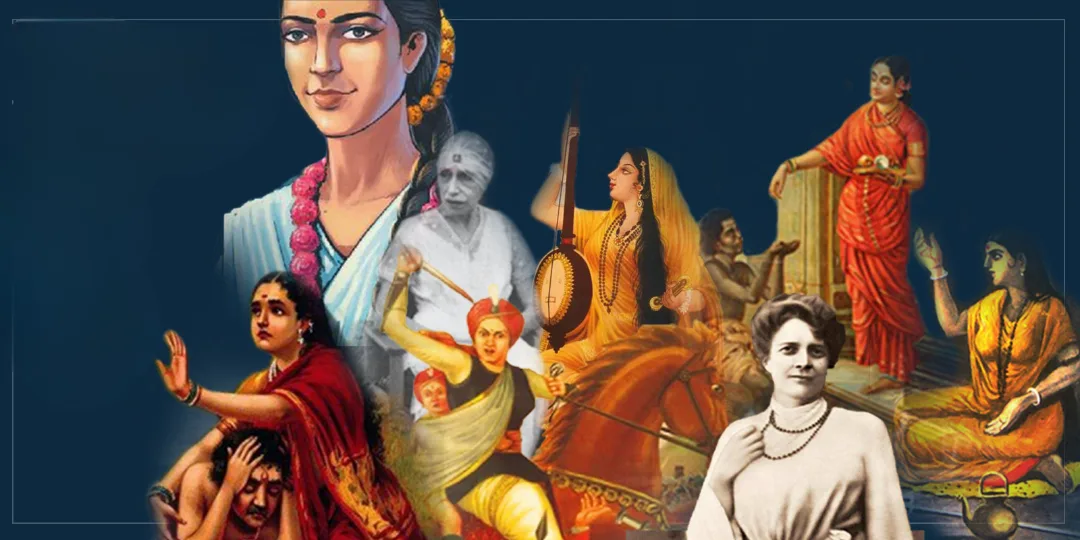
There was a time when Bharat was not merely a landmass but a living civilization — a pulsating consciousness built on harmony, reverence and interconnectedness. In that Bharat, woman was Shakti, the living force of creation; the one who nurtured, preserved and guided. She was not seen as separate from man, nor as his competitor or subordinate. Because in the Bharatiya drishti, woman was not a secondary creation. She is Prakriti — the creative energy of the universe, without which even Purush remains incomplete. This complementarity defines the Indian idea of Shrishti (creation). Compare this with the Western or Abrahamic traditions, where womanhood was seen differently.
- In the Biblical story, Eve was created from Adam’s rib, for his companionship.
- In medieval Islamic practice, women were often confined to roles of servitude or reproduction and slavery.
- Even in modern Western thought, womanhood became a political question of equality, not a spiritual question of reverence.
But in Bharat, woman was never “made from man”. She was Devi — divine in herself, the embodiment of creation, compassion and wisdom.
The woman as the axis of creation
Hence, the term equality never existed in Bharat. While modern discourse often seeks “equality” for women, Bharat’s civilizational wisdom goes deeper — it speaks of respect, which is higher than equality. Equality places two individuals’ side by side; respect places the other above, in reverence. In the Bharatiya ethos, the mother is not “equal” to anyone; she is revered. she is respected. Thus, women were never viewed merely through the prism of social status, but as bearers of Shakti — the power that sustains life and order.
When Bharat respected women as mothers, teachers and goddesses — Sita, Savitri, Gargi, Maitreyi — the civilization flourished. But over the centuries, through waves of invasion, colonization and cultural distortion, this vision — this drishti — first faded and then eroded. As that drishti eroded our cultural foundation weakened. Centuries of colonization and imitation have made us see womanhood through foreign categories — feminist or patriarchal, empowered or oppressed.
The shift in Drishti
Today, as India walks into the twenty-first century with renewed confidence, there is an urgent need to revisit how we view “women’s issues”. For too long, they have been understood through a western lens — a mindset that emphasizes difference rather than oneness. And in this borrowed view, the essence of the Bharatiya woman has been lost.
In western thought, everything begins with difference — how one is distinct, separate or superior. The Western gaze asks, “How different are we?” But the Bharatiya mind asks a different question altogether: “How are we connected?” This contrast in vision is not merely intellectual — it shapes how we live and how we organize society. The western model is built on fragmentation, on the individual standing apart from the whole. But Bharat’s worldview is built on samanvay — harmony and integration. Here, even the smallest act, thought or word carries consequence. Every effort has an impact that ripples across the web of relationships — from self to family, to society, to nation. Therefore, thinking only from one’s own or individual point of view is considered incomplete, even harmful in the long run. Individualism in itself cannot be central to our civilization — because Bharat never separated the “self” from the “whole”.
Drishti: The unchanging core
Human behaviour adapts to time and circumstance, but drishti — the way we see the world — must remain anchored. The Bharatiya drishti sees life as an interconnected continuum, where every being has a role in maintaining cosmic balance. Swami Vivekananda once said, “There is no chance for the welfare of the world unless the condition of women is improved”. His words were not about social reform in a narrow sense — they were about restoring the cosmic balance.
As the Bharatiya Nari reclaims her drishti, she must look inward — not merely demanding space in the system, but redefining the system itself in the image of dharma and harmony. This is what leaders like Param Pujya Sarsanghchalak Shri Mohan Bhagwat ji remind us of — that rebuilding Bharat is not about politics, but about conduct, consciousness and community. His guidance emphasizes that every citizen, especially women, should understand their role in protecting and nurturing the Parivar and the Samaj.
Women reclaiming the Kutumbh
The rebuilding of Bharat must begin where it all began — within the family. The Kutumbh is not a private arrangement; it is the basic samajik unit(social unit) of our civilization. A woman’s role in nurturing this unit is not merely domestic; it is nation-building. When she imbues her family with parampara (tradition) and sanskar (values), she strengthens the moral fabric of society. When she preserves harmony amidst diversity, she mirrors the very soul of Bharat. The woman’s role, therefore, is not confined to home; it is expansive — touching the spheres of culture, education, governance and thought. In every domain, she becomes the silent architect of a value-driven society.
When the Kutumbh (family) is strong, the nation remains unshaken. Throughout history, when invasions came to destroy our temples, our texts and our systems of knowledge, they could not destroy the soul of Bharat — because the Parivar, the family, remained intact. Within that unit, the woman stood as the moola-stambha — the central pillar of strength, continuity and value. It was through her — as mother, teacher and nurturer — that sanskaras (values) were transmitted from one generation to the next.
To build Bharat, women must see not only things but even themselves through the Bharatiya drishti — a vision that connects, integrates and uplifts. From this vision flows Shrishti (creation), Samskara (values), and Samarasya (harmony). In that awakening lies the resurgence of Bharat as Vishwa Guru — guided by the eternal strength of her women, the true builders of civilization. The story of Bharat’s future now shall be the story of her women because when they rise — rooted in tradition yet forward-looking — they do not merely participate in nation-building; they define it.
As for man, Bharat’s framework is distinct: here, women empowerment is not in opposition to man, but in alignment with the whole.














Comments