





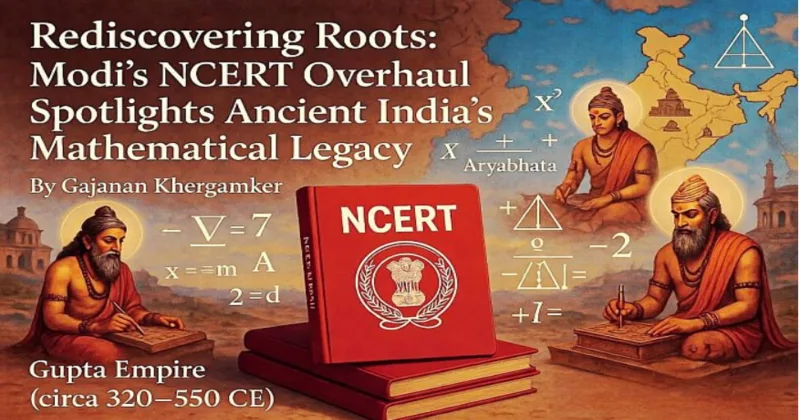
NEW DELHI: In a landmark move, the Modi government has directed the removal of historical distortions from NCERT textbooks, ensuring that India’s ancient contributions to global knowledge, particularly in mathematics and science, receive long-overdue recognition. The new editions of NCERT books will now highlight how Indian scholars like Aryabhata, Brahmagupta, Bhaskara, and Baudhayana laid the foundations of modern mathematics centuries before their Western counterparts.
According to officials, this revision aims to present a more accurate and culturally rooted narrative of India’s scientific legacy. The updated chapters emphasise India’s pioneering role in algebra, geometry, and trigonometry subjects that have often been attributed to Europe in traditional educational frameworks.
India’s Intellectual Legacy Reclaimed
The revised textbooks will include detailed discussions on:
- Aryabhata’s concept of zero and pi,
- Brahmagupta’s early work on algebra and quadratic equations,
- Baudhayana’s geometrical calculations, which predate the Pythagorean theorem, and
- Bhaskara II’s advanced mathematical methods that influenced later scientific developments.
By integrating these contributions into mainstream school education, NCERT aims to encourage students to take pride in India’s ancient intellectual heritage and understand how these discoveries shaped global progress.
A Shift from Eurocentric to Indic Narratives
For decades, Indian school textbooks were criticized for being heavily Eurocentric, often crediting European scientists for discoveries that originated in ancient India. The new editions mark a significant ideological and academic correction, portraying India as a knowledge leader rather than a passive learner of Western science.
Educationists have welcomed the move, calling it an “essential correction of historical imbalance.” Dr. Ramesh Pokhriyal, former Education Minister, remarked that India’s contributions to mathematics, astronomy, and medicine were “far ahead of their time and deserve rightful acknowledgment.”
Students across Classes 6 to 12 will soon see these changes reflected in upcoming NCERT editions. The revised chapters will include:
- Illustrative examples of ancient Indian mathematical techniques,
- Comparative timelines showing global scientific development, and
- Contextual notes highlighting India’s influence on later civilizations
This initiative is being seen as part of the Modi government’s larger effort to revive India’s civilizational confidence and instill national pride through education. By reintroducing India’s ancient knowledge systems, the new NCERT editions aim to inspire future generations to rediscover the intellectual brilliance that once made India the “Vishwa Guru” the teacher of the world.











Comments