





गङ्गे च यमुने चैव गोदावरि सरस्वति ।
नर्मदे सिन्धु कावेरि जलेऽस्मिन् संनिधिं कुरु ॥
In the rugged sweep of the Himalayas, where glaciers feed some of the world’s most vital river systems, water emerges as a critical axis of geopolitics. The Himalayan waters nurturing nearly 1.5 billion people are not merely a natural endowment but a strategic instrument shaping relations between India, Pakistan and Afghanistan. As climate pressures mount and transboundary tensions deepen, control and management of these waters have become central to South Asia’s security calculus.
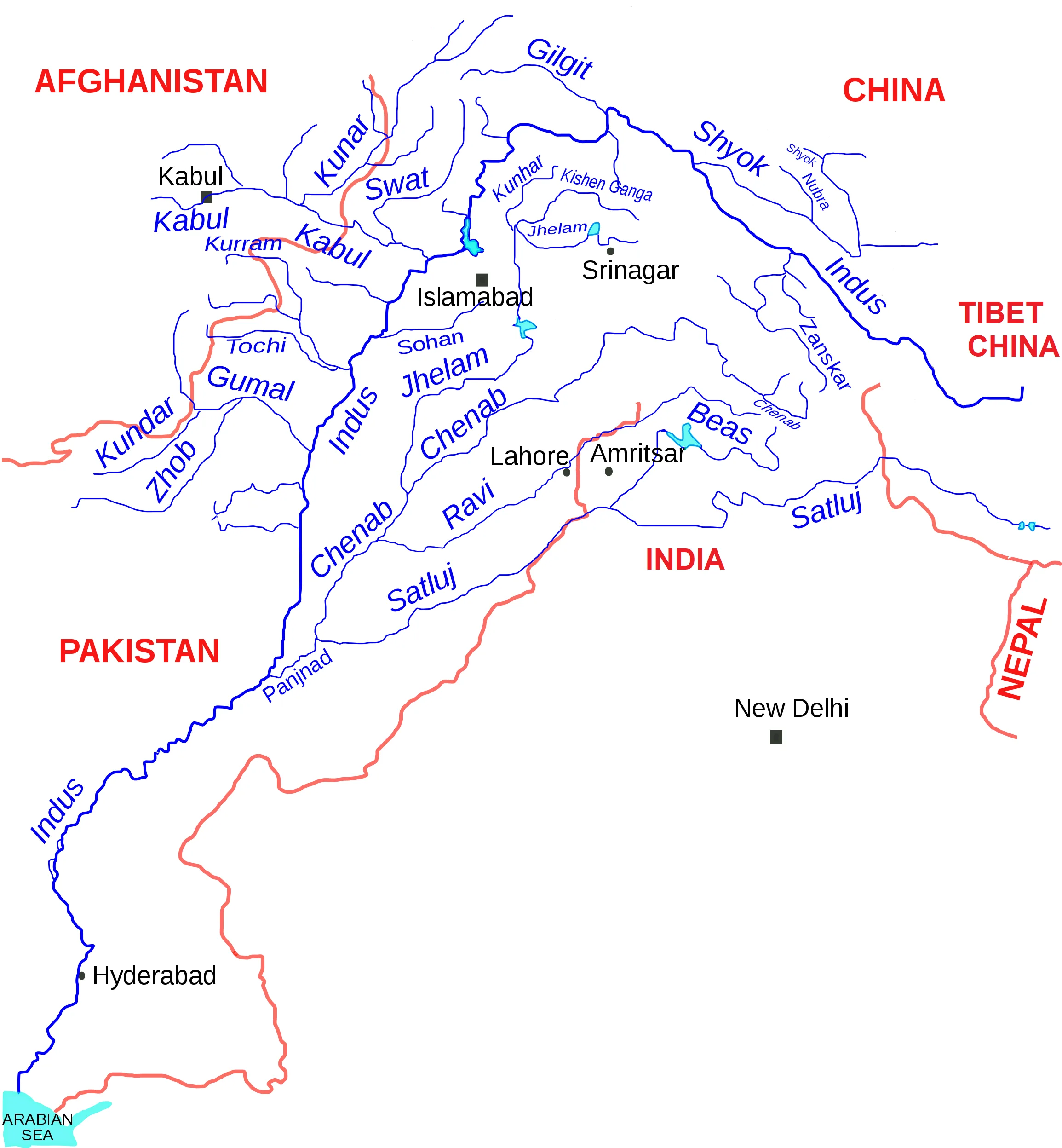
The Himalayas are our lifelines and are often called the Third Pole for their massive glacial reserves, give birth to three of Asia’s great river systems, the Sindhu, the Ganga and the Brahmaputra. Of these, the Indus River basin is the lifeline of Pakistan, sustaining nearly 80 percent of its agriculture and a large part of its population. Originating in Tibet, the Sindhu flows through the Ladakh region in India before entering Pakistan. Its western tributaries, Jhelum, Chenab and Kabul are crucial for Pakistan’s food security and hydropower generation. To the northwest, the Kabul River, originating in the Hindu Kush Mountains of Afghanistan merges with the Indus near Attock in Pakistan’s Punjab province. This river system binds Afghanistan and Pakistan in a complex hydrological interdependence, one that has gained fresh urgency as both nations explore new dams and water projects amid regional instability.
Originating in the Tibetan Plateau and flowing through Ladakh, Jammu and Kashmir and into Pakistan, the Indus system embodies both India’s upstream riparian advantage and the complexities of downstream dependencies. India’s geopolitical interests in this basin transcend hydrological management. They encompass dimensions of territorial integrity, economic modernization and strategic leverage within a volatile security environment. Consequently, Himalayan waters are no longer viewed as mere environmental assets but as instruments of statecraft embedded in India’s national security framework.
The Indus Waters Treaty: A Fragile Peace
At the heart of the India−Pakistan water equation lies the Indus Waters Treaty of 1960, brokered by the World Bank. The treaty divides the six rivers of the Indus system: the eastern rivers, Ravi, Beas and Satluj were allocated to India, while the western rivers, Indus, Jhelum and Chenab went to Pakistan. This framework has often been hailed as one of the world’s most durable water sharing agreements, surviving multiple wars and periods of diplomatic freeze. However, the treaty’s endurance has not translated into harmony. Pakistan has repeatedly expressed concern over India’s construction of hydropower projects in Jammu and Kashmir, such as the Kishanganga and Rattle dams, alleging violations of the IWT’s design provisions. India, on the other hand, maintains that its projects comply with the treaty and that it has the right to utilize the western rivers for non- consumptive purposes. In recent years, as India faces mounting domestic pressure to harness its water resources more effectively, voices within New Delhi’s strategic community have questioned the continued asymmetry of the IWT. It is a reality that we have under-utilized our share of the waters of the Ravi and the Beas, even as permitted to us under the IWT. Following the 2016 Uri and the recent Pahalgam attack, Prime Minister Narendra Modi famously declared that “blood and water cannot flow together”, signaling the potential use of water as a strategic lever in bilateral relations.
Afghanistan’s Emerging Role in the Indus Basin
While the India−Pakistan water dynamic dominates regional discourse, Afghanistan’s position in the Sindhu Basin is growing in strategic importance. The Kabul River, shared by Afghanistan and Pakistan, contributes up to 20 per cent of the Sindhu’s total flow. Yet there exists no formal water sharing agreement between Kabul and Islamabad. In recent years, Afghanistan has sought to develop its hydropower capacity and agricultural infrastructure through projects such as the Shahtoot Dam and the Surubi hydropower plant, with support from India and international donors. These initiatives, though crucial for Afghanistan’s development, are viewed in Pakistan with concern. Islamabad fears that upstream storage and diversion in Afghanistan could reduce flows into Pakistan’s already water stressed regions, particularly Khyber Pakhtunkhwa. India’s involvement in Afghan water infrastructure adds another geopolitical layer. Through its investments, India not only strengthens its developmental footprint in Afghanistan but also subtly influences water dynamics vis-à-vis Pakistan. In effect, water becomes a silent front in the larger strategic contest between New Delhi and Islamabad, played out through the shifting political terrain of Kabul.
Climate Change and the Cryosphere Crisis
Beyond political maneuvering, the Himalayan water question is being reshaped by climate change. The region’s glaciers are retreating at alarming rates by some estimates; nearly one third could disappear by 2100 if current warming trends continue. This will cause greater variability in river flows, leading to periods of both devastating floods and crippling droughts. For Pakistan, where agriculture employs over 40 per cent of the labor force, the implications are existential. India, too, faces increasing water stress, with rising demand from its growing population and energy sectors. Afghanistan, still rebuilding its institutions after decades of conflict, is ill-equipped to manage hydrological volatility. The combination of climatic uncertainty and political distrust could turn the Himalayan rivers from sources of sustenance into triggers of conflict.
Strategic Narratives, Water Diplomacy and the Road Ahead
Water, once viewed primarily as a developmental issue, has become a symbol of national sovereignty and strategic assertion. In Pakistan, any perceived threat to the Indus waters is framed as a matter of national survival. In India, the political discourse around water has evolved from cooperative development to strategic utilization. With new infrastructure projects in Jammu and Kashmir, India is effectively reclaiming its treaty rights, signaling both technological capability and strategic intent. Meanwhile, Afghanistan’s pursuit of upstream dams reflects its aspiration for self reliance and sovereignty, even as it risks tension with its downstream neighbour.
From a strategic communications perspective, India’s narrative can be reinforced along three vectors: (1) India has consistently adhered to the IWT and international hydrological norms, even under hostile conditions and has ensured its compliance with full legality; (2) India’s investments prioritize basin sustainability and shared prosperity rather than coercive control; (3)
By advocating inclusive frameworks such as South Asian Water Cooperation Forums, India positions itself as a norm-setter in hydro-diplomacy, paralleling its leadership in climate adaptation and disaster management. Such strategic communication not only enhances India’s moral authority but also undercuts attempts to internationalize bilateral disputes over water.
Amid these shifting dynamics, the region urgently needs a framework for cooperative water governance. The IWT, though outdated in certain respects, provides a foundational model for institutionalized dialogue. Expanding this to include Afghanistan potentially under a trilateral or regional mechanism could help manage the emerging Kabul River relevance. Data sharing, joint monitoring and basin wide planning can form the foundational and first practical steps toward trust building. Hydrological transparency, combined with investments in climate adaptation, could mitigate tensions. International actors such as the World Bank, the Asian Development Bank and the United Nations could play constructive roles in facilitating dialogue, funding climate resilient projects and ensuring equitable development.
The geopolitics of Himalayan waters is a story of both interdependence and insecurity. The rivers that sustain life across India, Pakistan and Afghanistan also bind their destinies in a fragile ecological and political balance. As each country grapples with domestic challenges, from energy shortages to climate impacts, the temptation to weaponize water as a tool of pressure will persist. Yet, water diplomacy also offers an avenue for peace building. Shared rivers can foster dialogue where politics has failed. In a region defined by historic rivalries, the pursuit of hydro-cooperation over hydro hegemony may be the only path to sustainable security. In the final analysis, the Himalayan waters are not just natural flows: they are the arteries of South Asia’s geopolitical future. Managing them wisely could determine whether the region drowns in conflict or rises on the tide of cooperation.
The geopolitics of Himalayan waters underscores the intersection of environment, security and strategy in South Asia. For India, managing the Indus Basin is not merely a technical or developmental challenge but a core component of its regional security architecture. Ensuring hydrological resilience while maintaining strategic leverage requires a calibrated balance of diplomacy, infrastructure and science. India’s position as an upper riparian with responsible stewardship offers both moral legitimacy and strategic advantage. Through proactive water diplomacy, infrastructural assertiveness and scientific engagement, India can transform hydro-political vulnerability into a cornerstone of regional stability and strategic influence.















Comments