





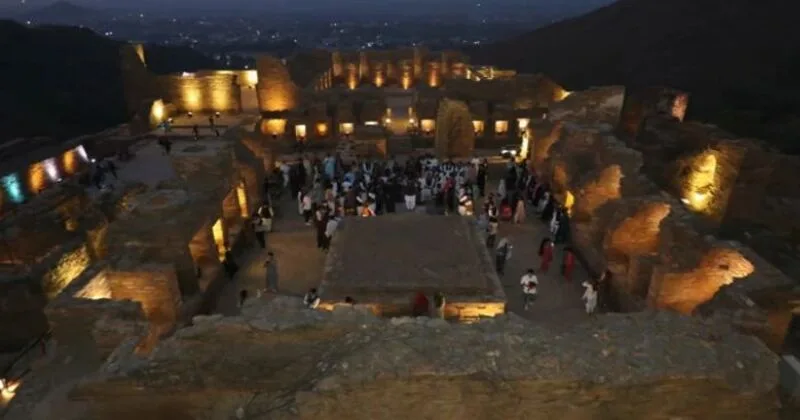
Italian archaeologists have recently uncovered a 1,200-year-old Mandir in the Khyber Pakhtunkhwa province of Pakistan. The Mandir is among eight ancient sites unearthed in Barikot (ancient Bazira), Swat, during excavations conducted by Italian archaeologists in collaboration with the Khyber Pakhtunkhwa Directorate of Archaeology. These sites are located along a stretch between Swat and Taxila.
Dr Luca, Director of the Italian Archaeological Mission, stated that the ruins of a small Mandir were excavated at the site. The excavation has been extended toward the Swat River to establish a protective buffer zone around the Mandir and surrounding archaeological layers.
The project is part of the “Khyber Path Project,” a three-year initiative launched on June 1 to promote regional development, provide employment opportunities, and offer hands-on training in excavation, heritage preservation, and management. Excavations are being conducted at multiple locations, and initial studies suggest the sites have been inhabited continuously from prehistoric times through the Islamic period. Among the discoveries is a fort dating back to the Ghaziabad era.
Italian archaeologists have reportedly identified around 50 sites across Khyber Pakhtunkhwa, spanning different historical periods, including the Stone Age, the era of Alexander the Great, the Greek period, Buddhism, the Hindu Shahi dynasty, and the early Islamic era. In the Tokardara area of Swat, several sites from the Buddhist period have also been found. The discoveries include numerous Buddha statues and a monumental stupa. Experts confirm that the site functioned both as a place of worship and as a Buddhist monastery, where students lived and received their education.
















Comments