





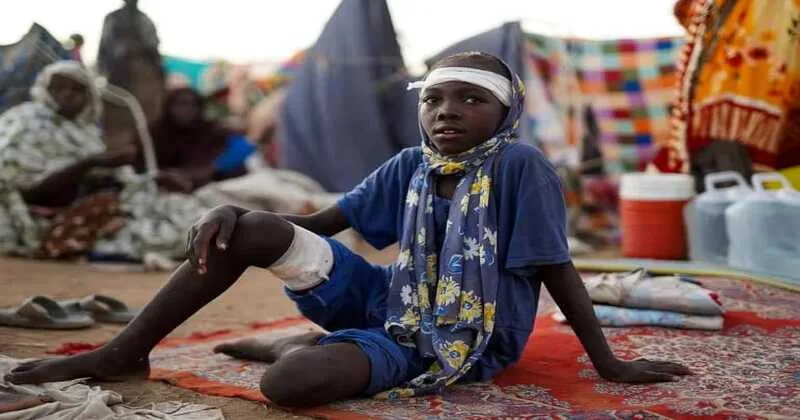
Videos of brutal killings of women and children in Sudan are circulating across the world, revealing shocking scenes of young families being executed in broad daylight. Public beatings, torture, and mass shootings are taking place as if they are justified under religious law. The civil war that erupted in April 2023 between Sudan’s official army and the paramilitary Rapid Support Forces (RSF) continues without pause. In what the United Nations has called the world’s largest humanitarian crisis today, more than 1.5 lakhs people have been killed and nearly 12 million have fled their homes.
This conflict is only the latest chapter in Sudan’s violent political history. Since the 2019 overthrow of long-time ruler Omar al-Bashir, who seized power in a 1989 coup, Sudan has plunged from one crisis to another. After Bashir’s fall, a civilian-military coalition briefly attempted to steer the country toward democracy. That government was toppled in yet another coup in October 2021. Today’s war centres on two former allies, General Abdel Fattah al-Burhan, head of the Sudanese Armed Forces and current president, and General Mohammed Hamdan Dagalo, his former deputy and leader of the RSF. Each is now fighting to control the country.
Oil, gold, and foreign hands behind the war
The RSF was formed in 2013 out of the notorious Janjaweed militia, the group widely blamed for genocide and ethnic cleansing against non-Arab communities in Darfur. Under the command of Mohammed Hamdan Dagalo, widely known as Hemeti, the RSF has grown into a powerful paramilitary force of more than 100,000 fighters. The group has been active in conflicts in Yemen and Libya, and today controls key gold-rich areas of Sudan. RSF leaders are accused of illegally exporting Sudanese gold to the United Arab Emirates, which in turn supplies the paramilitary with money, weapons, and drone support. Many of these weapons are reportedly smuggled through neighbouring Chad. The RSF also enjoys the support of Libya’s eastern strongman, General Khalifa Haftar. On the other side, the official Sudanese army is backed by Egypt, Turkey, and Iran. What has emerged is effectively a proxy war between rival Islamic powers, while Sudan’s impoverished Black African population pays the price.
The massacre in Sudan is so massive that you can literally see bloodstains from space, visible in satellite footage.
The Islamist-led ethnic cleansing is still raging on, relentless and unpunished.Where are the human rights activists??! pic.twitter.com/sDlf0vFikL
— ثنا ابراهیمی | Sana Ebrahimi (@__Injaneb96) October 29, 2025
In early June 2025, the RSF seized control of key border regions along Libya and Egypt. Although the capital Khartoum was captured by the RSF earlier this year, the army managed to regain it after intense fighting. But the war again shifted in late October, when RSF fighters captured El-Fasher, the last major army stronghold in Darfur. Since then, nearly the entire Darfur and Kordofan regions have fallen under RSF rule. The group has begun forming its own administrative structures in captured territories, effectively creating a parallel government. Sudan now stands on the brink of a second division. The first came in 2011, when South Sudan broke away, taking most of the oil fields with it. Today, the army controls roughly 60 per cent of Sudan’s territory, while the RSF holds the rest. The battle is now concentrated in Kordofan, a region rich in oil. Whoever controls Kordofan controls much of Sudan’s energy supply and, by extension, its political future. The region also holds great importance for landlocked South Sudan, whose oil exports pass through Kordofan’s pipelines.
Genocide of non-Muslims and non-Arabs
As fighting intensifies, civilians continue to flee in waves. After the fall of Bara—just 30 kilometres from El-Obeid—more than 20,000 people escaped toward the city. A total of 36,000 have fled Kordofan in recent weeks alone. The fall of Bara also coincided with the collapse of the army’s last defences in El-Fasher. It was here that RSF militants began mass killings, sexual violence, kidnappings, and systematic looting. Although the war initially revolved around political control and natural resources, it has now taken on a darker shape: genocide and religious cleansing.
Sudan is a Muslim-majority nation, with Muslims forming roughly 90.7 per cent of the population. Christians constitute 5.4 per cent, while the rest follow traditional tribal religions. Today, RSF fighters have shifted from general warfare to targeted killings of non-Muslims and non-Arabs. After capturing new areas, RSF gunmen have been lining up Christian and traditional-belief civilians, including women and children, and executing them while chanting “Allahu Akbar.” Entire communities are being wiped out.
More than two million Christians still live in Sudan, but they now face the worst persecution in decades. Over 165 churches have already been destroyed. Many priests, pastors, and believers have been kidnapped, assaulted, or murdered. International human rights monitors say that discrimination against non-Muslims has been severe for years, but the current conflict has given extremist elements open permission to kill.
In late November 2024, RSF militants attacked Bishop Younan Tombe Trill of the Catholic Diocese of El-Obeid. Both Catholic and Protestant groups condemned the attack, calling it proof that non-Muslims are being hunted. Indigenous religious communities are under similar threat. Those who follow ancestral tribal faiths are also being killed, with their villages destroyed and their properties seized.
The International Criminal Court (ICC) has classified the ongoing crimes in Sudan as war crimes and crimes against humanity. The ICC’s declaration came after global food-security experts confirmed that El-Fasher is on the brink of famine due to an 18-month food blockade imposed by the RSF. The United Nations-recognised Integrated Food Security Phase Classification (IPC) has separately warned that the town of Kadugli in South Kordofan is facing the most catastrophic level of hunger. In short, Sudan today is witnessing a religious and ethnic cleansing campaign, yet international response remains muted.
The silence of the world
What is most shocking is the silence of voices that otherwise claim to fight for human rights. The very activists and global campaigners who shed tears for conflicts in West Asia have barely spoken about Sudan. The global Left-Islamist lobby, which unquestioningly repeats the casualty figures released by Hamas-controlled authorities in Gaza, has offered no such sympathy for the victims of Sudan. Climate activist Greta Thunberg, who travelled to Gaza claiming to defend human rights and oppressed communities, has had nothing to say about the genocide in Sudan. Her silence is now being openly criticised. The masks have come off. The hypocrisy is visible.
Even in India, organisations that present themselves as champions of culture, human rights, and secularism have remained silent. The same groups that organise marches for Gaza have not protested the slaughter of non-Muslim and non-Arab Africans. Sudan’s forgotten genocide, fuelled by oil, gold, religious hatred, and foreign interference, continues as the world looks away. For millions of Sudanese Christians, ethnic minorities, and indigenous communities, the violence is not just a war. It is an attempt to erase them from their own land.




Comments