





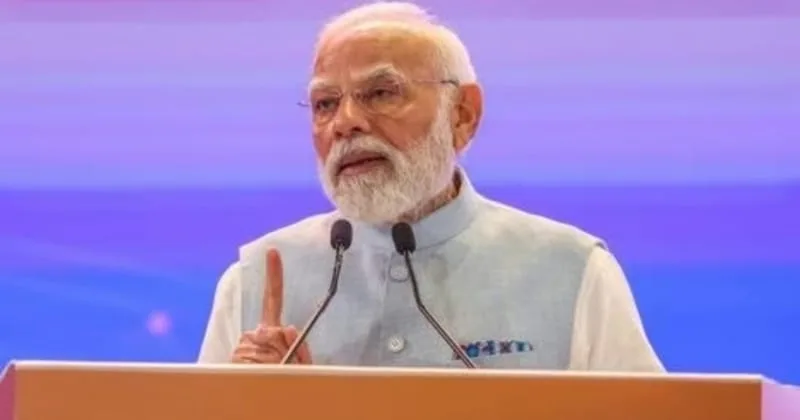
In a moment of pride for India’s higher education sector, Prime Minister Narendra Modi on November 4 hailed the record number of Indian institutions featured in the QS Asia University Rankings 2026, calling it a reflection of the country’s growing academic strength and research capacity.
Posting on X, the Prime Minister wrote, “Glad to see a record increase in the number of Indian universities in the QS Asia University Rankings over the last decade. Our government is committed to ensuring quality education for our youth, with a focus on research and innovation. We are also building institutional capacities in this sector by enabling more educational institutions across India.”
According to data released by QS Quacquarelli Symonds, India’s representation in the rankings has seen a remarkable 1,125 percent increase from 24 universities in 2016 to 294 in 2026. The country now stands second only to China, which has 395 universities listed, marking a 273 percent growth over the same period.
The QS Asia University Rankings 2026, released on Tuesday, feature 1,529 universities from 25 higher education systems, including 558 new entrants. India’s participation has expanded dramatically, positioning it as one of Asia’s most dynamic education systems.
India also leads the “Papers per Faculty” indicator, which measures research output and productivity, a sign of the strengthening academic culture across Indian institutions. Five Indian universities rank among Asia’s top 10 in this category, while 28 feature among the top 50.
“India’s remarkable rise in the QS Asia University Rankings 2026 reflects a decade of transformation in research productivity, innovation, and institutional capacity,” said Matteo Quacquarelli, Vice President (Strategy & Analytics) at QS Quacquarelli Symonds.
“As India marks five years since the launch of the National Education Policy (NEP) 2020, its impact is becoming increasingly evident,” he added.
Among the top performers from India are five IITs and the Indian Institute of Science (IISc), which ranked among Asia’s top 100 universities. IIT Delhi secured the 59th position, with others like IIT Bombay and IISc Bengaluru also featuring prominently.
The top three positions in Asia were claimed by University of Hong Kong, Peking University, and Singapore’s National University of Singapore (NUS) along with Nanyang Technological University (NTU), which tied for the third rank.
The National Education Policy (NEP) 2020, introduced by the Modi government, has been credited with driving a comprehensive overhaul of India’s education system, from promoting interdisciplinary studies to fostering innovation and international collaboration.
















Comments