





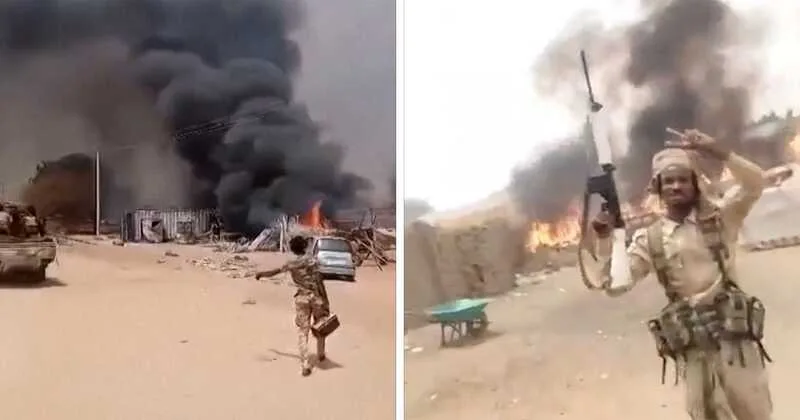
More than 2,000 non-Muslims were reportedly massacred within just 48 hours after the Islamist paramilitary group Rapid Support Force (RSF) seized control of the city of Al-Fasher in western Sudan. Most of the victims were women, children, and the elderly. According to the Sudanese Joint Forces, the atrocities occurred on October 26 and 27, marking one of the bloodiest episodes since the war began. Al-Fasher, the last major state capital in the Darfur region, fell to the RSF after more than 18 months of relentless siege. With this takeover, the RSF now controls all five state capitals in the Darfur region. The Joint Forces accused the RSF of committing “heinous crimes” and “acts of mass extermination” against innocent civilians.
The Rapid Support Forces, a brutal paramilitary organisation estimated to have around 100,000 fighters, roughly half the size of Sudan’s regular army, has a long, bloody record of religiously and ethnically driven violence. Emerging from the notorious Janjaweed militia responsible for the Darfur genocide of the early 2000s, in which an estimated 300,000 people were killed, the RSF’s origins are steeped in atrocity. The group, whose members are primarily Muslims, has been waging an Islamist crusade against non-Arab and non-Muslim communities. Led by Mohamed Hamdan Dagalo, known as Hemedti, the RSF has sought to consolidate control over Sudan’s gold mines, trade routes, and key territories, expanding its influence through terror, mass murder, and plunder. Local civil society organisations and international human rights groups had long warned that Al-Fasher’s fall could trigger catastrophic violence. Those fears have now been realised. Data released by Yale University’s Humanitarian Research Lab confirms a “systematic effort to ethnically eliminate, forcibly displace, and kill non-Arab indigenous communities”, particularly the Fur, Zaghawa, and Berti peoples. These groups, native to Darfur and parts of eastern Chad, are predominantly non-Arab and have historically practised mixed agricultural and nomadic livelihoods.
stand4palestineaus on IG
RSF EXECUTES CIVILIANS FOR TRYING TO FEED THE STARVING POPULATION OF AL-FASHER CITY !
UAE-backed militia known as the Rapid Support Forces (RSF) abducted and executed Sudanese men who when asked what they were bringing into the besieged city, responded… pic.twitter.com/QMWNQZ2vvW
— Nancy Abdallah🇺🇸🇵🇸🇾🇪🇱🇧🇮🇷 (@NanceAbdallah) October 27, 2025
House-to-house raids as RSF’s campaign of ethnic and religious cleansing in Al-Fasher
The massacre in Al-Fasher is a grim repetition of the genocidal tactics the RSF inherited from the Janjaweed. Survivors describe targeted killings, systematic executions, and entire families wiped out in cold blood. Local activists released verified footage showing civilians being shot dead in RSF-controlled areas. The AFP news agency has authenticated the videos, while human rights organisations have declared that the RSF’s actions “amount to war crimes and crimes against humanity, and may constitute genocide.” For more than 18 months, the Islamist jihadist RSF has besieged Al-Fasher, a city of 260,000 people, deliberately starving its residents and blocking humanitarian aid. The goal, according to the Joint Forces, is to “purify” or Islamize the city by exterminating non-Muslim populations. The RSF’s operations in Al-Fasher, they said, are a campaign of religious and ethnic cleansing designed to erase indigenous black African communities.
Reports from survivors indicate that RSF fighters conducted house-to-house raids to identify and eliminate non-Muslims, labelling the operation a “house-to-house clearance.” Witnesses recount scenes of unimaginable brutality, women and children executed in their homes, elderly people burned alive, and entire neighbourhoods flattened. Many of the victims belonged to the Fur, Zaghawa, and Berti communities, groups that have long been subjected to Arab supremacist violence in Darfur.
A nation in ruins and the use of starvation and siege as weapons of war in Sudan
The ongoing war between the Sudanese Armed Forces (SAF) and the RSF has devastated Sudan since April 2023, when a power struggle in the capital, Khartoum, erupted into open warfare. What began as a military feud quickly turned into a nationwide catastrophe, plunging Sudan into a brutal civil war. The conflict has displaced 13 million people and left nearly half of Sudan’s 51 million citizens dependent on food aid.
After months of intense fighting, the SAF recaptured Khartoum in March 2025, allowing some residents to return home. Yet, the violence in the country’s western and southern regions continues unabated. In May 2024, the RSF imposed a total siege on Al-Fasher, cutting off all supplies of food, medicine, and clean water. As the siege dragged on, hunger and disease claimed countless lives. Starvation became a weapon of war, used deliberately to weaken resistance and force mass displacement. Tens of thousands of civilians fled Al-Fasher, seeking refuge in the nearby town of Tawila, itself overwhelmed by hunger and suffering. Aid groups report an alarming number of children dying from starvation and untreated illnesses.
The RSF’s capture of Al-Fasher has also deepened Sudan’s political and territorial fragmentation. With control over all Darfur state capitals, the RSF now commands a de facto regime in western Sudan, rivalling the central government. Sudan risks a permanent east-west split, reminiscent of the country’s earlier division when South Sudan gained independence in 2011. The UN has voiced grave concern over reports that several foreign actors are supplying weapons and funds to the RSF, fuelling the cycle of violence. The atrocities in Al-Fasher lay bare the true nature of the RSF, a ruthless Islamist militia driven by ethnic hatred and hunger for power. Its actions are not isolated war crimes but part of a calculated campaign to erase entire communities. As the world looks on, Sudan’s civilians continue to pay the price of international inaction. The blood-soaked streets of Al-Fasher stand as a grim reminder that Darfur’s genocide never truly ended; it has returned under a new name, with the same barbaric intent.












Comments