





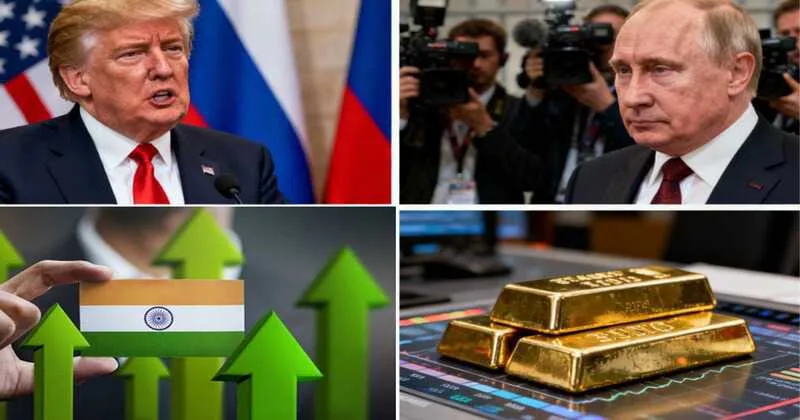
Gold prices recorded their steepest one-day fall since 2013 in the international market, sending ripples across global commodity exchanges. The sudden plunge has caused anxiety among investors while bringing relief to prospective jewellery buyers. The price of gold, which had touched a record $4,381 per ounce, dropped dramatically to $4,009.80 within a single trading session, before recovering slightly to around $4,089. Analysts said the correction was inevitable after the metal’s prolonged rally and profit-booking among investors added to the downward pressure. The fall is expected to be mirrored in the domestic market in India today.
The decline followed reports suggesting a possible thaw in the trade tensions between the United States and China, with discussions being considered to end the long-standing trade war. These developments prompted investors to liquidate their holdings, anticipating improved global economic stability, a scenario that traditionally weakens demand for gold, regarded as a ‘safe-haven’ asset.
Gold loses its safe-haven shine
Gold usually benefits from uncertainty, whether due to economic slowdown, geopolitical friction, or trade disputes. However, the growing perception that such risks may ease has opened the way for profit-taking. The recent ceasefire agreement between Israel and Hamas in Central Asia further contributed to the drop, as investors moved funds back into riskier assets. Another key factor has been the strengthening of the US dollar index against a basket of six leading global currencies, including the euro, yen, and pound sterling. A stronger dollar makes gold costlier for buyers holding other currencies, adding to the downward momentum.The wave of profit-taking was not confined to gold alone. Exchange Traded Funds (ETFs) tied to both gold and silver came under pressure. The international silver price fell from $54 per ounce to $48, and analysts expect this correction to reflect in local silver rates in India as well.
Market observers anticipate heightened volatility in gold prices in the coming days. The confirmation of a possible meeting between US President Donald Trump and Chinese President Xi Jinping has also stirred optimism among investors. Many expect the easing of hostilities between the world’s two largest economies to spur global growth and strengthen stock markets, both scenarios that are typically unfavourable for gold.
However, analysts caution that if the much-anticipated talks fail to yield an agreement, the precious metal could rebound sharply. Trump has warned that if no trade deal is reached by November 1, the US will impose an additional 155 per cent import tariff on Chinese goods. Meanwhile, expectations that the US Federal Reserve will cut its benchmark interest rate by 0.25 percentage points in its upcoming meeting have added another layer of uncertainty. A rate cut would typically weaken the dollar, which could, in turn, lend support to gold prices. Despite silver’s current price pressure, there remains significant industrial demand for the metal. Silver is widely used in solar panels, electric vehicles, artificial intelligence components, and coinage, ensuring a firm long-term outlook despite near-term corrections.
Putin–Trump talks collapse amid deepening differences
Efforts to arrange a meeting between Russian President Vladimir Putin and US President Donald Trump have collapsed as disagreements between the two sides widened. Trump stated that there was no point in proceeding with discussions that were “certain to be fruitless,” effectively calling off the planned engagement. Putin had maintained that a peace settlement could be achieved if certain regions of Ukraine, including Donbas, were ceded, a proposal that drew strong opposition from France, Britain, Germany, and Italy. Italy criticized Moscow’s approach, saying that Russia appeared to be taking peace negotiations “lightly.” Trump’s shifting position on military assistance to Ukraine has further complicated matters. Although he initially signalled that Washington would supply Kyiv with long-range Tomahawk missiles, he later reversed his stance, drawing criticism both domestically and abroad.
Russia, on the other hand, remains adamant that it will not agree to any ceasefire conditions for the time being. The Trump–Putin meeting, which was expected to take place in Budapest, Hungary, has therefore been indefinitely postponed.The diplomatic impasse is compounded by logistical and legal hurdles. For Putin to travel to Hungary, the European Union would first need to lift its flight ban on Russian aircraft, a step European leaders are unwilling to consider. Moreover, Putin is subject to an arrest warrant issued by the International Criminal Court (ICC). While Hungary has stated that it would not detain him, Germany has insisted that any EU nation hosting the Russian leader should carry out the ICC’s order.
These conflicting positions have made it impossible to proceed with the meeting. Trump has described the Ukraine–Russia conflict as “a graver crisis” than both the Israel–Hamas and India–Pakistan disputes, underscoring the scale of global tension surrounding the issue. A preparatory meeting between US Secretary of State Marco Rubio and Russian Foreign Minister Sergei Lavrov, planned to precede the leaders’ summit, has also been cancelled. Diplomats now indicate that the two may instead hold a telephonic conversation in place of a face-to-face meeting.
Japan’s export miss drags down Asian markets
While American stock markets rallied on the back of strong quarterly corporate earnings, the mood in Asian markets turned cautious following disappointing export data from Japan. In the United States, indices hit record highs, buoyed by improved performances from leading companies. The Dow Jones Industrial Average climbed 0.47 per cent, closing at a historic 46,924 points, while the S&P 500 and Nasdaq Composite also edged higher by 0.16 per cent each. Investor sentiment was lifted by robust quarterly results from firms such as Coca-Cola, while General Motors shares surged 15% after the automaker forecast stronger revenues for the upcoming quarters. Conversely, Netflix stock dropped 6% due to weaker-than-expected earnings, and markets are now awaiting Tesla’s quarterly results, due to be released today.
However, in Asia, markets retreated after Japan’s Ministry of Finance reported that exports rose 4.2 per cent last month, ending a four-month slump but still below analysts’ expectations of 4.6 per cent growth. The weaker data prompted selling across regional exchanges. Japan’s Nikkei 225 fell 0.81 per cent, while China’s Shanghai Composite Index slipped 0.08 per cent, and Hong Kong’s Hang Seng Index declined 0.66%. In Australia, the ASX200 dropped 0.80 per cent. European defense stocks, however, experienced strong gains following the collapse of the Trump–Putin dialogue. Anticipation of prolonged geopolitical uncertainty pushed up the shares of several defence and security firms by as much as 10 per cent. Consequently, London’s FTSE 100 Index rose 0.25 per cent, while Germany’s DAX added 0.29 per cent.
Indian markets closed for Deepawali
In India, both the Sensex and Nifty remained closed today due to Deepawali holidays. The markets had also observed a holiday yesterday, marking a rare two-day closure for consecutive public holidays. On Monday, trading was limited to the traditional Muhurat session, held to mark the beginning of the new Samvat year 2082. The brief session saw modest gains, with the Sensex up by 62 points (+0.07 per cent) and the Nifty advancing 25 points (+0.10 per cent). At one stage, the Sensex had risen by as much as 270 points, while the Nifty briefly crossed the 25,900 mark. Gains in Infosys, HDFC Bank, and Mahindra & Mahindra lent support to the indices.













Comments