





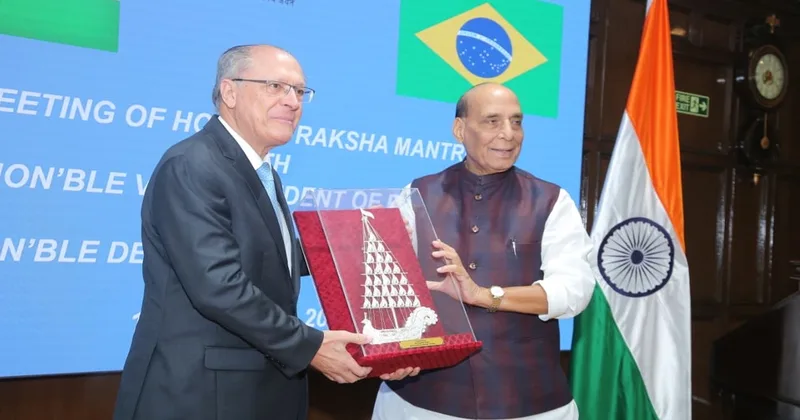
In a major step to strengthen the defence ties with Latin America, India has proposed supplying its indigenous Akash air-defence missile system to Brazil. This offer emerged during discussions between Indian Defence Minister Rajnath Singh and Brazil’s Vice President Geraldo Alckmin, where defence cooperation and strategic partnership were key topics.
India’s proposal goes beyond a simple arms sale. It is part of a broader partnership, which may include co-developing and co-producing defence systems. During the talks, both countries identified key areas for collaboration in defence manufacturing. The aim is to move from a basic buyer-seller relationship to a deeper technological partnership.
The Akash system is a medium-range surface-to-air missile (SAM) developed by India’s Defence Research and Development Organisation (DRDO). It is built to intercept aerial threats like fighter jets and missiles within a range of about 25 to 30 km, with more advanced versions in the works. The Indian military has recently tested its performance at high altitudes, including over 15,000 feet in the Ladakh sector. These tests show that the system can engage high-performance aerial targets in challenging conditions.
From India’s point of view, this offer to Brazil brings multiple strategic benefits. It supports India’s goal of becoming a major player in global defence exports. By introducing the Akash system in a significant Latin American market like Brazil, India aims to showcase its defence manufacturing capabilities and build its reputation as a defence technology provider. It also expands India’s geopolitical reach. Strengthening ties with Brazil, a key member of the BRICS group and a prominent voice in the Global South, helps India build alliances beyond its traditional regions.
For Brazil, the interest is similarly strategic. Brazilian defence planners are seeking modern air defence solutions to protect their large territory and address changing regional threats. India’s offer presents an opportunity to access a mature yet upgradable system and possibly localise some production or maintenance through co-production agreements. However, Brazil is also considering other options for its medium and long-range air defence needs, including the EMADS (Enhanced Modular Air Defence Solutions) from Western suppliers. This reflects Brazil’s careful approach to balancing cost, performance, and technology transfer.
Despite its potential, the proposal faces genuine challenges. Brazil’s security needs, especially regarding low-altitude, high-speed threats like drones or cruise missiles, require systems with quick response times and high sensitivity. Some reports indicate that previous Brazilian assessments raised concerns about the Akash’s suitability for these evolving threats. The stakes are high; any Indian offer must convincingly show that the missile system can compete with or surpass other technologies in performance, integration and support throughout its life cycle.
In diplomatic terms, the timing of India’s proposal is significant. This move occurs as India and Brazil are also working on enhancing trade links through frameworks like MERCOSUR, aiming to boost their economic engagement. Thus, the defence offer aligns with a larger strategic goal: integrating trade, technology and security for a more cohesive India-Brazil partnership.
If successful, the deal could set a new standard for India’s defence diplomacy. It would not only involve exporting hardware but also creating strategic, industrial and political ties with rising powers worldwide. A collaboration on advanced missile technology between Brazil and India could broaden India’s role in global defence supply chains while providing Brazil with an alternative to traditional arms suppliers.
However, achieving success will depend on addressing gaps in performance, trust, financing and strategic alignment. India must ensure that Brazil sees the technical advantages of the Akash system, as well as a commitment to ongoing support, upgrades and joint innovation. In the coming months, as negotiations continue, the India-Brazil defence dialogue will serve as a crucial test for India’s evolving position as a defence exporter and partner. If the Akash offer gains traction, it could signal a new phase in India’s engagement with the Global South, combining military technology, industrial collaboration and diplomatic strategy.















Comments