





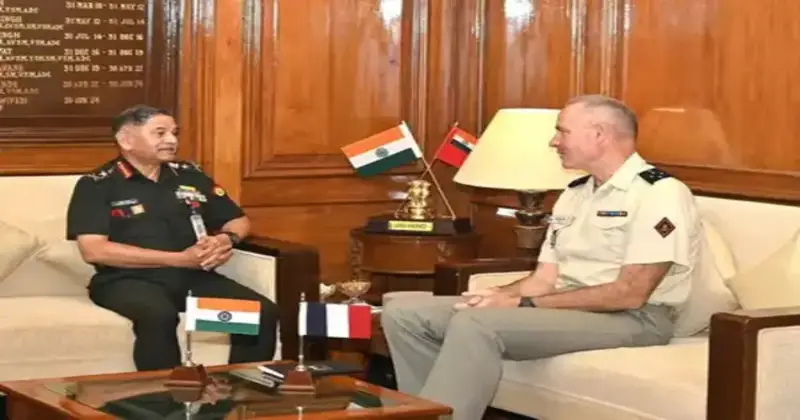
In a breakthrough path to boost the India-France defence partnership, the French Army has exhibited significant interest and aspiration in purchasing the Indian weapon systems. The main reason underlying the interest shown by Paris towards Indian weapons is that they are war-tested and has proved its stellar effectiveness and credibility during Operation Sindoor.
The Chief of the Army Staff of the French Army General Pierre Schill was on a visit to New Delhi to participate in the United Nations Chiefs of the Counter-Terrorism Conference 2025. On the sidelines, the Chief of the Indian Army, General Upendra Dwivedi held bilateral discussions with his French counterpart to boost the New Delhi-Paris defence collaboration.
Both the sides held a wide range of discussions and reaffirmed about strengthening the Indo-French strategic partnership in the domain of joint training & exercise, counter-terrorism operations, enhanced cooperation in UN Peacekeeping operations etc. The highlight of the meeting was France has shown keen interest in purchasing the indigenous defence technologies of India.
This includes India’s long-range weapon systems, loitering munitions and other emerging battlefield technologies. While speaking to the media, General Pierre Schill has hailed the indigenous defence capabilities of India including that of the missiles and the artilleries. He also cited and appreciated the weapons’ incredible effectiveness during Operation Sindoor. For example, France is considering the purchase of ‘Pinaka’, an all-weather multi-barrel rocket launcher(MBRL) developed by DRDO.
General Pierre Schill described ‘Pinaka’ as cost-effective and simultaneously delivers precise and accurate solutions. Moreover, it suits the requirements and compatibility of the French Army. With respect to the indigenous loitering munitions and counter-drone systems, French Army Chief praised its operational effectiveness and swift integration capabilities. He hailed the unparalleled precision capability of the unmanned defence technologies developed in India. For example, the ‘Saksham’ drones drew the attention of General Pierre Schill due to its real-time effectiveness under crucial combat circumstances.
Statements by General Pierre Schell highlighted the increasing aspiration among the fraternity in Paris to bolster defence collaboration with New Delhi in an era of spiking geopolitical uncertainties and highly unpredictable multi-domain warfare. The confidence of France expressed towards India’s indigenous defence technologies is also a testament to the growing global feat achieved by India in defence indigenization and self-reliance, not just for the sake of domestic benefit but that also helps to solidify the security architecture across the partner countries that ultimately aids in restoring the balance of power.
The Indo-French defence partnership has high-stake strategic significance. India has a deal to purchase 62 Rafale fighter jets from France which includes 36 for the Indian Air Force and 26 more marine Rafales are also being purchased for the Indian Navy. These Rafale fighter jets also played a pivotal role in marking India’s strategic edge during Operation Sindoor. Further, with the goal of revolutionizing India-France defence relations, General Upendra Dwivedi had visited France earlier this year, during which discussions were held in consolidating the New Delhi-Paris defence collaborations in terms of joint exercises or technology transfer.
Post Operation Sindoor, the global demand for the indigenous defence technologies of India have been raising starkly, for the reason being the weapons are war-tested and the world has witnessed its effective functioning in battle fields and combat scenarios. The Akash missiles, Pinaka rocket launcher and many other drone systems have been widely demanded in countries such as Philippines, Vietnam etc. India has been exporting its defence products to more than 80 countries, thus emerging as the key defence manufacturing and export hub.











Comments