





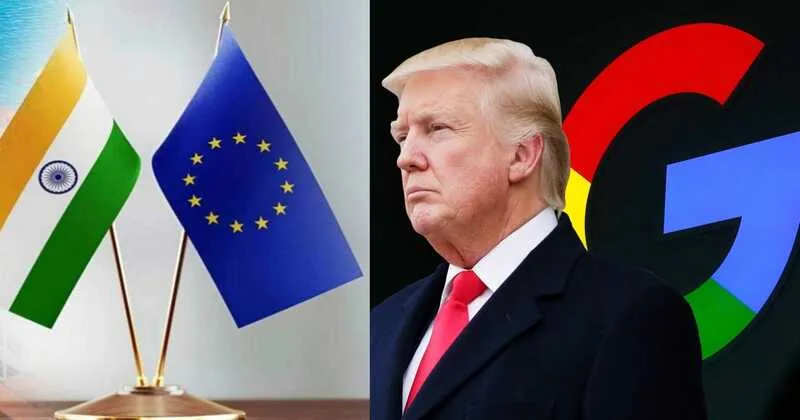
The European Commission announced that it would continue negotiations on a free trade agreement with India following significant progress in talks last week. The development is seen as another success for the Indian government in its quiet efforts to counter the tariff war initiated by US President Donald Trump. According to the Commission, additional rounds of virtual and in-person discussions are scheduled in the coming days.
Spokesman Olof Gill highlighted that the talks in Brussels last week achieved notable progress. He confirmed that an agreement had been reached on sanitary and phytosanitary measures, regulations that govern the control of pests, diseases, and waste that can affect human, animal, and plant health. Such measures often become major obstacles in agricultural trade negotiations between countries. The European Commission emphasised that discussions are advancing with the goal of finalizing the trade agreement by the end of the year. Trade Commissioner Maros Sefcovic and India’s Commerce Minister Piyush Goyal are leading the negotiations. Gill noted that all key issues related to the availability of goods in both industrial and agricultural sectors had already been thoroughly discussed. The European Union’s engagement with India comes in the context of heightened US tariffs. Last month, Trump imposed an additional 50 percent tariff on Indian oil imports from Russia, while the EU itself faces 15 percent tariffs on various goods from the United States. Analysts suggest that these developments are pushing the EU to diversify its trade partnerships, making India an increasingly important economic partner in global politics.
Alphabet’s $15 billion AI investment highlights India’s rising tech and economic clout
Meanwhile, Alphabet, the parent company of Google, announced a $15 billion investment in India, a move seen as another challenge to Trump’s economic strategy, which encourages American companies to prioritise domestic investment. The investment will establish Google’s AI hub in Andhra Pradesh, forming part of its global AI Centers Network that spans 12 countries. Google Cloud CEO Thomas Kurian said that the India facility will be the largest AI hub in the world and the company’s largest investment outside the United States. The project is scheduled for completion over the next five years. Kurian highlighted that India’s low operational costs and rapidly expanding internet user base make it an ideal location for AI and cloud infrastructure.
Technology companies worldwide are increasingly viewing India as a strategic partner for cloud and AI expansion. Alphabet CEO Sundar Pichai stated that the investment will provide cutting-edge technology to Indian industries and users while fostering innovation in the AI sector. He added that the initiative is expected to significantly contribute to India’s technological and economic progress. These developments, both in trade negotiations and strategic technology investments, underscore India’s growing role as a global economic hub and reflect its ability to navigate a complex geopolitical and trade environment successfully.














Comments