





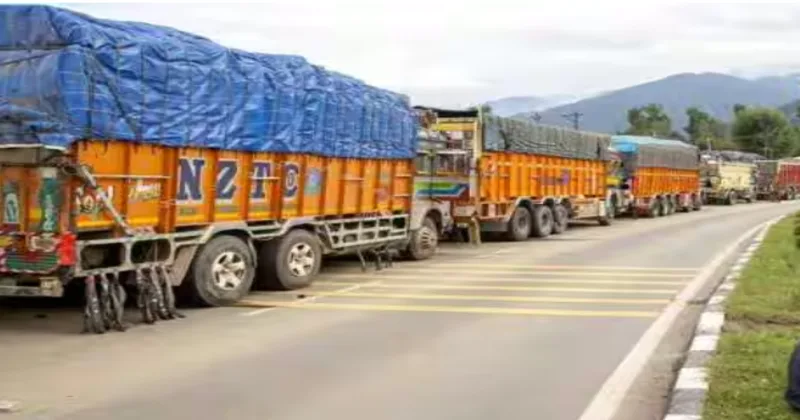
The Jammu-Srinagar national highway (NH44) was reopened for heavy vehicles on September 17 after a three-week closure caused by heavy rains and flash floods. This led to hundreds of fruit-laden trucks from the Kashmir valley mandis like Shopian and Sopore to move towards markets across the country. Besides, heavy vehicles started moving towards Srinagar also but the traffic police is regulating the movement at many points which could prove to be bottlenecks.
Two days earlier, the administration had allowed movement of heavy trucks laden with fruits to move via Shopian-Pir ki Gali route on Mughal Road to facilitate the movement of fruits. This is unprecedented as due to steep ingradient and narrowness on some stretches, the Mughal Road is off-limits for heavy trucks. According to officials dealing with the problem of a glut in the mandis, at least 2,200 loaded trucks were cleared via Mughal Road to reach Jammu and travel beyond. Divisional Commissioner of Kashmir Anshul Garg had coordinated these efforts to help the horticulturists.
This step, of using the Mughal Road for heavier trucks, besides the start of a daily freight parcel train between Nowgam (Budgam) and Adarsh Nagar in Delhi, had come as huge reliefs for the horticulture sector. With the reopening of the traditional highway 44, preferred by the truckers for carrying goods, the situation is likely to ease out altogether by the weekend.
The 270-km arterial road, shut last month due to extensive damage, had partially reopened for light motor vehicles last week. Senior Superintendent of Police (Traffic-Rural) Ravindra Singh said clearing stranded fruit trucks was the top priority. Despite hectic efforts by the National Highway Authority of India (NHAI) engineers and workers, one stretch of road at Tharad in Udhampur had remained a major challenge all this while.
“All stranded vehicles along the highway and those at fruit mandis will be cleared on priority,” Singh said, urging drivers to follow advisories and avoid overtaking to prevent accidents and fresh blockades. It may be mentioned here that hundreds of trucks laden with goods meant for Kashmir valley, and some even meant for Ladakh region, have remained stranded for many days. These are likely to move towards their designated destinations but the movement is likely to be slower than usual despite the widening of the highway.
The prolonged closure had raised concerns among fruit growers over losses, as the Mughal Road—used as an alternative route, is not considered suitable for heavy vehicle movement. Of course, it served its purpose for some time but there is no chance of it emerging as an alternative route to the main highway. Authorities said the reopening is expected to ease pressure on Kashmir’s horticulture sector, which relies heavily on the highway for transporting produce to terminal markets across India.
Meanwhile, Lieutenant Governor Manoj Sinha inaugurated a Bailey Bridge on the Ramban-Gool road, terming it a lifeline for nearly 1.5 lakh people residing in Ramban, Sangaldan, and Gool areas. LG Sinha, in a post on X, said the bridge will improve connectivity, ease of living, and provide relief to people who had suffered due to recent natural calamities that caused infrastructure damage, economic hardships, and disruption of the vital route.
The 150-foot Triple Panel Double Storey Extra Wide Reinforced Bailey Bridge, is designed to ensure heavy traffic bearing capacity. BRO, NHAI, Ramban district administration assisted the Army engineers of White Knight Corps (16 Corps with headquarters at Nagrota) in executing the task. According to a press release issued by the Press Information Bureau (Defence Wing), over 5,000 people were provided relief by the Army at different locations. Several medical camps were also held to reach out to stranded villagers located in remote areas.
It needs to be mentioned here that dozens of roads in the hinterland all over the Union Territory (UT) of J&K were damaged due to heavy rains in the last week of August. Most of these roads have been repaired to restore connectivity but it can be only considered a temporary measure. The complete rehabilitation of connectivity will be a costly affair that may take several months, according to officials.
On Wednesday, the pilgrimage to the cave shrine of Shri Mata Vaishno Devi also resumed though the number pilgrims is only a trickle as of now. This was perhaps the longest pause or suspension of yatra outside the Covid period triggered by heavy rains. The pilgrimage is likely to pick up in a day or two as the word spreads further and farther. The restoration of more trains to Katra, the base camp for the shrine, in the coming days leading to the Navratri, beginning on September 22, is expected to improve things gradually.
Meanwhile, most government as also private schools have reopened in all the 10 districts of the Jammu region after a closure of almost three weeks. The teaching staff had been going to the schools since September 8 (Monday) but no students were being allowed in pending safety audit of all school buildings. It was a cumbersome process but on Tuesday, the schools saw students back in classes. For the next few days, the weather is likely to be clear with light rains at some places but generally fair.















Comments