





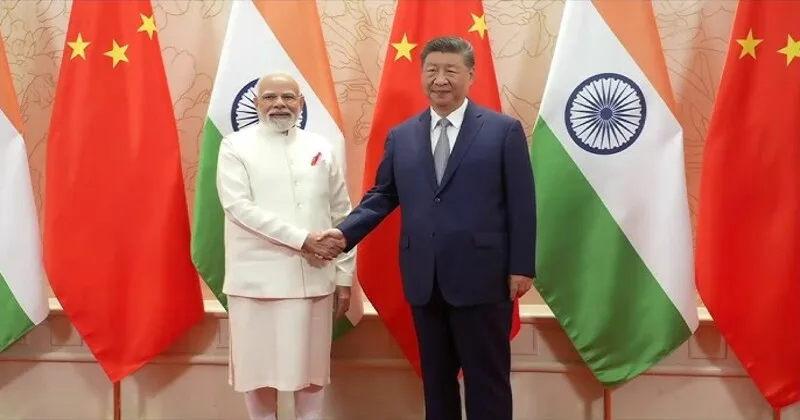
Prime Minister Narendra Modi and Chinese President Xi Jinping, during the bilateral meeting in Tianjin on the sidelines of the 25th SCO summit, recognized the role of India and Chinese economies in stabilizing the world trade against all the volatilities, the Ministry of External Affairs said in a statement on August 31st. The affirmation by New Delhi and Beijing comes as the world is grappling with US President Donald Trump’s irrational and unreasonable tariffs.
The US specifically has imposed a 50 per cent tariff on New Delhi, including the additional 25 per cent tariffs for purchasing oil from Russia. Meanwhile, US had imposed a levy of 30 per cent on China but has paused it for 90 days as the both nation are negotiating a trade deal. Earlier trade war between Washington and Beijing had escalated to as high as 245 per cent tariff, before receding to 30%.
“On economic and trade relations, they recognized the role of their two economies in stabilizing the world trade. They underlined the need to proceed from a political and strategic direction to expand bilateral trade and investment ties and reduce trade deficit. Predictable economic and trade cooperation between India and China helps stabilize world economy”, MEA said in the statement. The two leaders also reviewed the progress of bilateral relations since their meeting in Kazan last year and emphasized the importance of stable and amicable ties to realize the economic growth of both the nations.
In a post on X, Official Spokesperson of MEA, Randhir Jaiswal said, “PM Narendra Modi met President Xi Jinping on the sidelines of the SCO Summit in Tianjin, China. The two leaders reviewed the progress of India-China bilateral relations since their meeting in Kazan last year. Stable and amicable ties between India and China are important for our economic growth, for reformed multilateralism and for a multipolar world and Asia.”
PM @narendramodi met President Xi Jinping on the sidelines of the SCO Summit in Tianjin, China.
The two leaders reviewed the progress of 🇮🇳-🇨🇳 bilateral relations since their meeting in Kazan last year. Stable and amicable ties between India and China are important for our… pic.twitter.com/bP8JRugdjM
— Randhir Jaiswal (@MEAIndia) August 31, 2025
Additionally, during the bilateral meeting, PM Modi noted that India and China both should pursue their relations on the principle of strategic autonomy and their relations should not be seen through a third country lens. The two leaders deemed it necessary to expand common ground on bilateral, regional and global issues and challenges, like terrorism and fair trade in multilateral platforms.
Meanwhile, New Delhi and Beijing has agreed to resume direct flight connectivity between the Chinese mainland and India at the earliest, and finalize an updated Air Services Agreement. They also agreed on the facilitation of visas to tourists, businesses, media and other visitors in both directions. India and China have also resumed the Kailash Manasarovar Yatra this year, a decision which EAM Jaishankar appreciated during his meeting with Chinese Vice President Han Zheng in Beijing.
Chinese Foreign Ministry statement asserts on mutual cooperation and development
According to a statement by the Ministry of Foreign Affairs of China, during the Modi-Xi bilateral talks, Xi Jinping emphasized that this year marks the 75th anniversary of the establishment of diplomatic relations between China and India. In this backdrop, both sides should view and handle China-India relations from a strategic and long-term perspective, further elevate them through the Tianjin summit and promote the sustained, healthy and stable development of bilateral relations.
Both nations should strengthen strategic communication and deepen mutual trust. As long as they remain committed to the overarching principle of being partners, not rivals and provide development opportunities, not threats, for one another, China-India relations will flourish and move forward steadily and will achieve win-win results. Both China and India are at a critical stage of development and revitalization. They should focus on development as their greatest common denominator, supporting, promoting and achieving mutual success, Chinese Foreign Ministry statement further added.
New Delhi and Beijing should also accommodate each other’s concerns and uphold harmonious coexistence. They should work together to maintain peace and tranquility in the border areas and not let the border issue define the overall China-India relationship. Cordial Sino-India relations will ultimately aid for the peace, prosperity and development of Asia and the world, said the statement from the Foreign Ministry of China.
(With Inputs from ANI)










Comments