





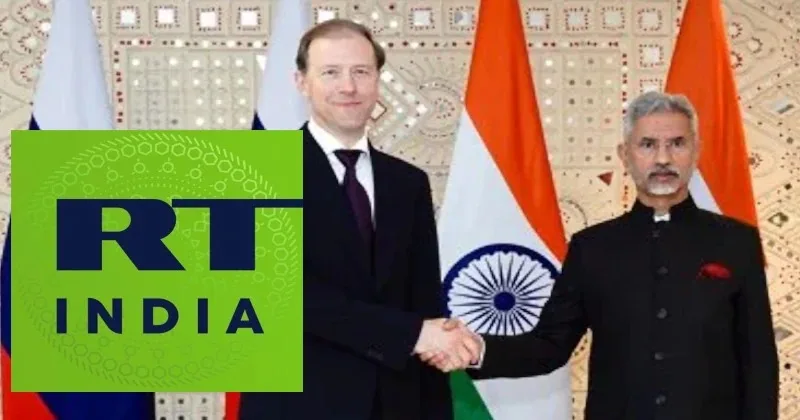
Russia’s state-backed media network Russia Today (RT) is set to launch RT India TV in New Delhi by the end of 2025. The announcement was made by Russia’s Deputy Prime Minister Denis Manturov during high-level talks with Indian External Affairs Minister Dr S Jaishankar in Moscow.
Manturov described the initiative as a significant step in strengthening bilateral cooperation not just in trade and defense but also in the information and media space. “This will allow detailed coverage of events in Russian-Indian relations as well as objectively reflect the growing role of our countries in the modern multipolar world,” he said.
The launch of RT India TV is part of Moscow and New Delhi’s broader strategy to challenge Western media dominance and create an alternative platform that reflects the perspectives of both nations. The channel is expected to provide extensive coverage of geopolitical issues, bilateral cooperation, and global developments from a Russia-India lens.
Analysts suggest that this media collaboration comes at a critical juncture when Washington has escalated its economic confrontation with New Delhi, imposing a 50 per cent tariff on Indian goods. For India, this makes strategic media and trade engagement with Russia not only a matter of diplomacy but also of necessity in counterbalancing Western economic pressures.
Addressing business leaders in Moscow, Jaishankar highlighted India’s rapid economic growth and the urgent need to diversify trade relations with Russia.
“An India with a GDP of USD 4 trillion plus, growing at 7 per cent for the foreseeable future, has an obvious need for large resources from dependable sources. In some cases, it could be assured supplies of essential products, fertiliser, chemicals, and machinery. Our rapidly growing infrastructure offers business openings to enterprises with an established track record in their own country,” he stated.
He further stressed that while India and Russia have nurtured one of the steadiest relationships between major nations, this has not translated into sufficient economic depth. “Our trade basket remains limited, and so too has our trade volume. Both the diversification and balancing of trade now urgently mandate more strenuous efforts on our part,” Jaishankar added.
Jaishankar also announced that India has concluded the Terms of Reference for the India–Eurasian Economic Union Free Trade Agreement (FTA), calling it a landmark step that could redefine trade flows between the two regions. Beyond trade, discussions also included joint ventures, high-value investments, and collaboration in sectors like technology, energy, and infrastructure.
He emphasised the government’s role in creating conditions for economic activities, but urged businesses on both sides to seize opportunities. “In the final analysis, what we really need is for businesses to step forward confidently. Not just that, also ensure close collaboration between what Governments are discussing and businesses are planning,” he said.
S Jaishankar’s remarks and Manturov’s announcement come at a time when India faces an unprecedented tariff wall from the United States. After imposing a 25 per cent duty on Indian goods, Washington has escalated the tariff to 50 per cent effective August 27, targeting India’s exports in a move widely seen as punitive.
For New Delhi, this tariff hike could accelerate its push for alternative trade routes and partnerships. Moscow, eager to strengthen its own economic and media presence in Asia amidst Western sanctions, has found in India a dependable partner willing to deepen cooperation.


Comments