In the remote village of Dedara in Gujarat’s Surendranagar district, queries from potential clients continue to pour in for Baldevbhai Mohanbhai Rathore.
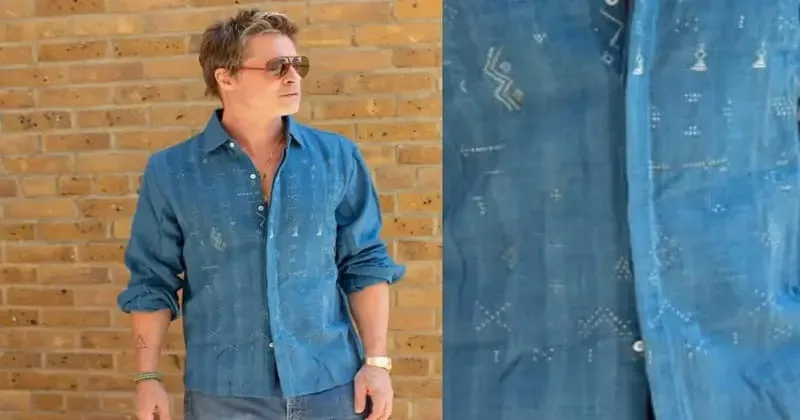
The surge in attention began after actor Brad Pitt was spotted in an indigo shirt during behind-the-scenes moments from his film F1. The shirt features Tangaliya craftsmanship—an intricate handwoven art Baldevbhai has mastered.
The piece was created under the fashion label 11.11 / eleven eleven, which operates as the prêt line of CellDSGN Pvt. Ltd. Baldevbhai has been collaborating with CellDSGN Pvt. Ltd. for over five years, bringing his traditional expertise to contemporary fashion.
The shirt worn by Brad Pitt is no ordinary garment. Made from indigenous cotton that is hand-spun and hand-loomed, it features delicate, bead-like motifs woven entirely by hand using the traditional Tangaliya craft.
Brad Pitt’s film F1 premiered in theatres worldwide on June 25, 2025, with its North American release following on June 27.
Tracing Tangaliya
The Tangaliya weave, with a legacy spanning 700 years, originates from Gujarat’s Surendranagar district. This intricate craft is preserved and practiced by the Dangasia community, known for its deep-rooted weaving traditions.
“I worked on Tangaliya weaving using yarn supplied by the fashion house (CellDSGN Pvt Ltd), and I was paid Rs 8,500 for it about eleven months ago,” says Baldevbhai, who has also passed down the art to his sons, keeping the age-old tradition alive.
Legacy of Tangaliya Weaving
According to local lore, the origins of Tangaliya weaving trace back to a union between a boy from the Bharwad (shepherd) community and a girl from the Wankar (weaver) community. The couple made a living by weaving shawls using wool provided by the Bharwads. Their children, born of this fusion of traditions, came to be known as the Dangasia—dang meaning stick and sia meaning to go—who went on to preserve and evolve the unique art of Tangaliya weaving.
Traditionally, the women of the Bharwad community were the primary patrons of this fabric, which was originally crafted from coarse wool woven by local artisans. Over time, the craft evolved, but its distinctive character remains intact.
What sets Tangaliya apart is its signature raised dot motif—known as danas. These tiny bead-like dots are formed by twisting extra weft yarn around several warp threads, creating a textured, embroidery-like appearance. These motifs, often geometric, appear identically on both sides of the fabric, showcasing the weaver’s precision and skill.
“Earlier, I worked only with wool. Today, I also use cotton and silk yarns for Tangaliya weaving,” says Lavjibhai Parmar, a veteran artisan who received the Padma Shri earlier this year for his contribution to the craft.
The motifs commonly depict elements from the artisan’s environment—mor (peacock), jhaad (plant), naughara (nine-dotted house), among others. Locally known variations of Tangaliya include Ramraj, Charmalia, Dhusla, and Labdi.
“Tangaliya is a technique of wrapping fibre on warp threads during the weaving process. It has been handed down from one generation to the next,” adds Lavjibhai, reflecting the enduring heritage of this intricate and culturally rich textile tradition.
A Craft Nearly Lost
Tangaliya was on the verge of fading into obscurity until timely intervention came from the state government and other key institutions. The Gujarat State Handloom and Handicrafts Development Corporation Ltd. played a pivotal role in identifying, reviving, and promoting Tangaliya through development programs, marketing support, and product outreach.
The National Institute of Fashion Technology (NIFT), Gandhinagar, also made a significant contribution. In 2007, it helped form the Tangaliya Hastkala Association and guided weavers in exploring new possibilities beyond traditional wool. By introducing cotton and silk into their weaving practice, the institute enabled Tangaliya to reach a wider, more fashion-conscious audience.
Still, challenges remained. “Tangaliya wasn’t bright or bold like Bandhani or Patola, so it was often overlooked in fashion events,” admitted a designer, speaking anonymously. The subtle elegance of Tangaliya’s motifs made it less eye-catching on the runway, at least initially.
Recognition and Revival
Government efforts eventually bore fruit. In 2009, Tangaliya was granted the Geographical Indication (GI) tag, a milestone that formally recognised the uniqueness of the craft.
Artisans, too, began receiving long-overdue recognition. Lavjibhai Parmar, one of the foremost Tangaliya weavers, was honoured with a National Award in 1990, the Sant Kabir Award in 2019, and the prestigious Padma Shri in 2025. Baldevbhai Mohanbhai Rathore, another master weaver, received both national and state awards in 2016.
In rural Surendranagar, the revival has also taken a grassroots form. Families have established common facility centres to train the next generation in Tangaliya weaving. Lavjibhai, for instance, provides both technical and market support to trainees and has employed 20–25 weavers, creating new livelihood opportunities in the region.
A Craft Finds Its Market
Today, Tangaliya products are showcased at exhibitions and are available through collaborations with vendors across India. Weavers have embraced digital platforms as well, selling their work online. Their creations are also stocked at Garvi Gurjari, Gujarat government-run outlets in India and abroad. The product range now includes not just shawls, but also cushion covers, bags, purses, and even office files featuring Tangaliya patterns.
And now, with Hollywood star Brad Pitt donning a Tangaliya-woven indigo shirt in his film F1, the world has finally taken notice of this rich tradition. The global spotlight has landed squarely on Gujarat—and on a centuries-old craft that refuses to fade away.