





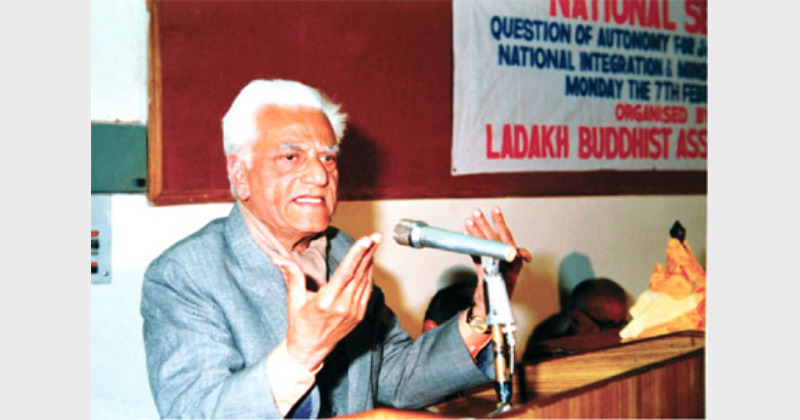
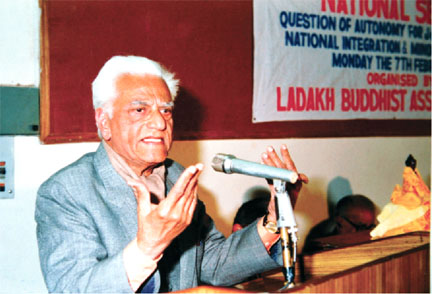
 Kewalram Ratanmal Malkani aka KR Malkani took over as the Editor of Organiser in 1948, at the age of 27 after an initial stint with The Hindustan Times as a Sub-editor. The youngest and longest serving editor of Organiser, he continued editing the weekly till 1983. At one stage he also simultaneously edited, The Motherland, an English daily, a sisterly publication of Organiser, between 1971 and 1975. He was a Nieman fellow at Harvard University during 1961-62. He was also the General Secretary of the Editors’ Guild of India during 1978-79. Later he also served as a politician as a Vice President, BJP (1991-1994), Member, Rajya Sabha (1994-2000) and as Lieutenant Governor of Puducherry from July 2002 till his death in October 2003.
The Midnight Knock (1977), The RSS Story (1980), The Sindh Story (1984), Ayodhya and Hindu-Muslim Relations (1993) are some of his well-received books
Hemandas Motwani
My journey with Organiser began prior to the Indo-China War in 1962 and continued till April 30, 2000 after serving for 37 years in different capacities. I am witness to many ups and downs in the history of Bharat Prakashan (Delhi) Ltd. I feel Organiser was at its peak during the period of Shri LK Advani and Shri KR Malkani, who both enjoyed very good tuning and were always eager to provide something different to the readers, which they did not get anywhere else. Even after joining active politics Advaniji continued to contribute in Organiser.
The vision and news sense of Malkaniji was exemplary, which was basically the most important factor behind the growth of the newspaper. It was during that period that Organiser was widely and frequently quoted in different newspapers and the Parliament. However, it made Organiser an eyesore for the Left parties and the Congress. As a result when we used to approach companies for advertisements, they said “Take money as donation, but don’t publish our advertisement, otherwise the Congress leaders would harass us”. It gradually proved to be a big hindrance for years and the company faced financial crisis occasionally.
“Fear, We Not”Within four days of the declaration of the Emergency, an amendment came into effect in the MISA rules, doing away with the obligation to communicate the grounds for detention to all those detained on June 25 and the following days. |
Another hindrance was that we did not have our own printing press and whatever quality, good or bad, they provided we had to accept. Following financial crisis we used to search the printer which printed the paper on cheapest rate. Naturally, when one wants low rates, how can one expect good quality? It was always a major challenge before us. Sometimes, we were so much financially poor that we had to take money through hundis. It was costly affair, but we had no other option. In those days many newspapers indulged in manipulations to procure big quota of newsprint, but we never indulged in any such manipulation. As a result the newsprint we got was less than our requirement and rest of the papers was purchased from black market. The suppliers knew that we did not have money to pay immediately, they sold us paper on higher rates, which ultimately resulted in major loss every year. In those days Malkani was Organiser and Organiser was Malkani. It benefited us. Kidarnath Sahni was a very resourceful person. He is responsible for constructing the huge building for Bharat Prakashan at Jhandewalan, which proved to be big financial help to us in the form of rent.
Organiser’s Fight for Press Freedom The RSS, a Hindu right-wing group, ran (and continues to do so) an English weekly in Delhi called the Organiser. Brij Bhushan was its printer and publisher while KR Malkani was its editor. On March 2, 1950, the chief commissioner of Delhi imposed a prior restraint on the Organiser under Section 7(1)(c) of the East Punjab Public Safety Act, 1949 which extended to Delhi as well. Under this provision, a provincial |
Once we published a special issue of Organiser on West Bengal. I ensured free distribution of some copies in the Rajdhani Train going to Calcutta in those days. It helped us in making new subscribers and also receiving advertisements. Many people phoned us to know more about the publication.
In 1971, when East Bengal war broke out, we decided to publish an evening daily under the same title of The Motherland. It was a four page daily printed on the broadsheet. The experiment proved to be a big hit. It was the initiative of news editor Shri DR Mankekar who had come from Times of India. In those days, the evening daily of Hindustan Times was in the market at around 4.00 pm. But we distributed our issue at 2.00 pm only. On first day itself, I personally went to Coffee Home in Connaught Place and sold copies to the people. We had priced it one aana, which attracted the hawkers. Since I was incharge of all the local hawkers for The Motherland, I personally knew most of them. On third day, there was long queue of hawkers outside the printing press for copies. The eveninger continued till the Into-Pak war continued. One interesting benefit of the evening daily was that it increased the circulation of our morning edition too. It enhanced the image of the entire publication.
When The Motherland was started in February 1971, the news of Jana Sangh and RSS associated organisations received very scant space in the mainstream media. The Motherland was started to basically fill that gap. Then we purchased a lino composing machine. An old printing machine was also purchased from Rajkot. The machine was installed in the basement of Deendayal Research Institute.
The prime reason behind huge demand of Organiser and The Motherland was out of the box vision of Malkani ji in selection and presentation of the news and articles. It was the only newspaper of opposition parties. Hence, not only the Sangh people, but also the opposition leaders read it. Even the Embassies were our subscribers. The copies started reaching London through Central News Agency. In order to enhance my skills and keep me updated I used to attend various workshops and seminars held anywhere in the country. It equipped me with new ideas. Workers’ training is very much useful in any institution. Since the company hardly provided money for attending the workshops and seminars, I attended them paying money from my own pocket. It was because of this experience that I got a very good offer from Punjab Kesari next day of my retirement.
In those days there used to be weekly holiday in many daily newspapers. But we in The Motherland decided not to have any holiday and published the paper every day. We cared for not only our employees, but also for the hawkers associated with us. To be successful in a newspaper, what is required the most is to publish what the readers want. If you fail to do that, you cannot run a paper. Once, Organiser earned a good profit. Shri Ramshankar Agnihotri was the General Manager. He provided double bonus to the employees. Sahniji was instrumental in providing wages to the employees according to the Wage Boards. After Emergency we purchased two scooters for the circulation and advertisement staff.






Comments