





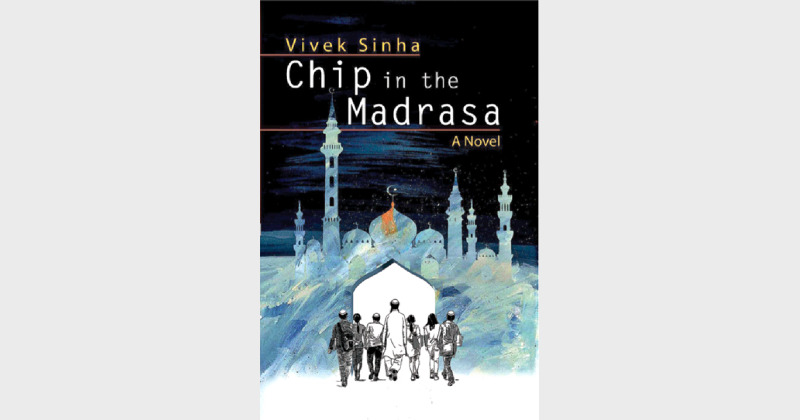
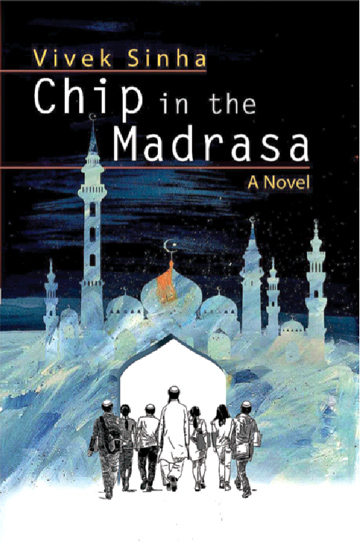
| Chip in the Madrasa (Paperback); Vivek Sinha; (Available on Amazon) Pp 310; Rs 495 (Free sample available for kindle) |
Nidhi Bahuguna
 Vivek Sinha is a Journalist and a filmmaker. He has made a documentary on Muzaffarnagar riots.The book, Chip in the Madrasa, is a testimony to painstaking research and a grassroot connect with the subject of Muslims in India, especially in the forgotten hinterlands ‘200 km from Delhi’
The book deals with the struggles of an Islamic scholar ‘Maulvi Saab’ spanning across a generation.The gripping tale deals with the Maulvi”s attempt to modernise the village madrasa starting with introducing modern subjects and his struggle for bringing computers into the Madrasa.
The tale is gripping. The sample leaves the reader with an urge to read the story and purchase the book. The book is a fiction but the characters echo real people we see around. The events mentioned are those that surface regularly on TV debates and appear as small paragraphs in print media-fatwas issued, news of mobs wanting to ‘save Islam’ going on rampage,Islamic preachers like Zakir Naik capturing the mind space of gullible Muslims, worries of creeping Wahhabism, Urdu papers fuelling the Wahabi narrative and the heady cocktail of politics and media fuelling the narrative of Muslim victimisation.
New ArrivalsSell: The Art, the Science, the Witchcraft (Hardcover); Subroto Bagchi; Hachette India; Pp 256; Rs 499 In his new book, Sell – the first book on the subject by an Indian practitioner of business – bestselling author and inspiration to generations of entrepreneurs, Subroto Bagchi presents the concepts of selling and salesmanship from his unique perspective. Bagchi crystallises his on-the-ground knowledge about salesmanship through stories and anecdotes. A comprehensive and contemporary treatise on the art, science and ‘witchcraft’ behind selling, Sell will redefine the meaning of salesmanship. Islam: Muslims and Non-Muslims (Paperback); Dr KV Paliwal; Hindu Writers’ Forum; Pp 107; Rs 50 The book, Islam: Muslims and Non-Muslims, presents relevant Ayats of Quran that throw light on the spirit and content in relation to Muslims and non-Muslims. The English translation of the Quranic ayats quoted in this book has been taken from “The Meanings of the Illustrious Quran” by Abdullah Yusuf Ali which is considered as an authentic translation of Quran by several Islamic scholars. It also contains a compilation of the quotes of eminent Indian scholars, historians, statesmen and saints on Islam. |
The moderate, rational Indian Muslim who is by and large silent and does not figure in the high-pitched narrative of Muslim victimisation, is the protagonist in the novel. The educated modern Indian Muslim who wants
education and employable skills as a means to escape poverty is a threat to Wahhabism and politicians who depend on ignorance and victimisation of the community to fuel their ambitions.
The book deals very deeply with the creeping Wahhabism that has been funded by petrodollars for decades and how it captures the mind space of ignorant Muslims through narrow interpretations of Islam and Quran. The educated moderate Muslim is isolated and pressurised by his own community to conform or is at the receiving end of Fatwas.
Though the book is a fiction, it opens a gateway into the unknown world of Muslims living in villages in the hinterland. The Madrasa is the centre for learning. The small paragraph one has read about a brave Maulavi who made students sing the national anthem in a Madrasa and was issued fatwa-such incidents get a context in the book. The support to Islamists by FPI in the book for political gain and funding is eerily similar to certain parties in Parliament.
The ‘Saudi returned’Islamic preacher who issues a fatwa against a Maulavi who has bought Computers to his village Madrasa, is eerily similar to another preacher who is absconding now.The book gives a very vivid description of a moderate, educated Indian Muslim and the isolation such middle-class Muslims are facing on Islamic issues.
In the present context, the book makes a very relevant reading. The 1986 Shah Bano case was where a Muslim woman took the might of ‘Islam in danger’ lobby. Reading the book puts the whole struggle and its aftermath into context, how Wahabis placed people believing in their ideology into political powerful seats to influence the law-making.
The present furore over singing the National Anthem, the insistence of certain parties to bring in Sharia laws for Muslims, social activists supporting medieval Islamic Sharia laws as rights of minority-and stories of ordinary Muslim men and women opposing these and standing by their version of true Islam, can be understood by reading the book.
The present Triple Talaaq issue is a manifestation of the struggles and challenges Indian Muslims face due to the imposition of Wahhabism through Petrodollar- funded NGOs and Madrasas. Though the book does not deal with Triple talaaq issue,it has uncannily forecast this. The speech of Union minister of state for Foreign Affairs MJ Akbar delivered in the Lok Sabha could have been written by the Maulvi Saab of the book ,had he been around, whereas the words of the opposing camp supporting Triple talaaq could have been written by any of the characters who oppose the progressive thought process and the deep understanding of Islam by Maulvi Saab and seek to impose their narrow interpretation of the same .
To conclude, the book Chip in the Madrasa is a very honest and very brave effort indeed. It is not a politically correct book as it questions many predetermined assumptions. The book takes one into the alleys of the hinterlands, provides glimpses of what we see fleetingly in news reports. It brings into the picture the need to modernise Madrasas and helps us to understand both the support and the opposition.
The message of the book is put in these words“…the first and foremost thing a pious and true Muslim should do is to open up his mind. Let thoughts and ideas come from all sides…never try to close your mind.” What better way to do this than install Chip in the Madrasa!



Comments