





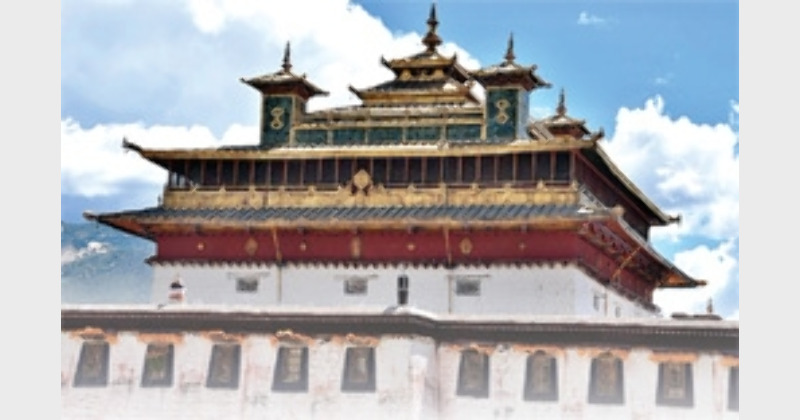
Intro: Pandit Kamalashila famously defeated the Chinese abbot Mahayana Hashang in the great debate at Samyé (the first monastery built in Tibet), which took place around 792 AD, ensuring that the Tibetans followed the Indian tradition of Madhyamika which had flourished at the great Nalanda Monastery.
I am not talking about the conventional wars of this century when in 1962 silence of the Himalaya was broken at Nathula by guns and mortars or when recently Indian Tibetan Border Force (ITBP) and Chinese army were physically seen pushing each other at the border in Arunachal Pradesh on national TV channels. It is about a great debate that established the Nalanda tradition of Buddhism in Tibet by the Indian Pandits.
I am amused to read media reports by Indian journalists who were recently invited by China to Lhasa to this years’ Shoton festival and who heaped praises on freedom of religion in Tibet because ‘people are allowed to celebrate cultural festivals’ etc. We need to understand that, China’s freedom of religion rests with the philosophy that has the approval of the communists Government and of their culture to attract tourists. None of the Indian journalists cared to understand the plight of the legacy of the great Indian Pandits who established the Nalanda tradition of Buddhism in Tibet and, whether the freedom of practicing that philosophy in the manner taught by the masters being followed in the current can be rightly called ‘freedom of religion.’
After the establishment of the Buddha Dharma in Tibet by Guru Padma Sambhava in the 7th century, there also began an attempt to introduce Chinese form of Buddhism by Chinese master Hashing, or Heshang Mo-he-yan. King Trisong Deutsen began to suspect that the visiting Chinese teacher Hashang, was not teaching the true dharma and hence a dispute arose between the two schools of Buddhism and it started spreading in Tibet. As advised by Khenchen Shiwatso (Mahapandit Shantarakshita or Boddhisatva), the king entrusted Pandit Kamalashila, principal disciple of Shantarakshita, most trusted and one of the brightest scholar from Nalanda University to lead the debate. The great council of Lhasa or the great debate lasted for two years from 792 to 794 at Samye. These scholars were all defenders of the Madhyamaka School, the spirit of Nalanda tradition. At the end of the great debate, Hashang was defeated by Kamalashila.
As was the rule those days, the king then issued a proclamation naming the Nalanda tradition of Buddhism as the official faith for Tibet and Chinese master, Hashang was banished from Tibet. Thus India became the sole source of importation of Buddha Dharma and to this day Tibetan Buddhism follows and practice the translated texts taught by the 17 great Nalanda Pandits from Nagarjuna and Asanga to Atish Dipankar.
With the enthusiasm of the Bihar Government and encouragement by the then President of India Dr Abdul Kalam, the project for revival of this great ancient university was taken up by the state Government in 2006. However, the central Government took over the project and the spirit with which Bihar Government originally planned it got diluted. Exactly after 1220 years of the great debate in Samye, where the Nalanda Pandits defeated the Chinese Buddhists, the Nalanda University is revived in India, where this time China ensured that the Dalai Lama and Tibet does not find any mention in the history of the university. Even other leading Asian Buddhist countries such as Sri Lanka, Thailand and Myanmar which has number of scholars of international reputation did not find mention in the message of the new Chancellor.
The message of Chancellor Dr Amartya Sen, appointed by Dr Man Mohan Singh openly stated that religious studies could be imparted without involvement of religious leaders. “He (the Dalai Lama) is heading a religion. Being religiously active may not be the same as (being) an appropriate person for religious studies,” Sen said. Besides, a Vice-chancellor who is paid Rs 5 lacs a month and her friend OSD who is paid Rs 3.5 lacs a month, the University also has Ms Upinder Singh, daughter of the then Prime Minister Manmohan Singh, and her colleague Ms Nayanjot Lahiri as advisers representing India in international platforms. Nalanda Monastic University in Bihar was established by the Gupta Dynasty, survived for 600 years and was destroyed in 1203 by Turkish Muslim invaders, whereafter the last throne-holder (abbot) Shakyashri-bhadra, fled to Tibet. Although, it was the Tibetan Buddhists who kept the “Nalanda tradition” and the teachings of Buddhism’s Mahayana sect alive till date in Tibet and that the Dalai Lama is the biggest promoter of the philosophy of Nalanda tradition globally, yet the UPA government, in order to respect the Chinese sensibilities not only assured disassociation with the Dalai Lama but the entire message of the new Chancellor aimed at crediting the spread of Nalanda philosphy to the other Asian countries and to Chinese masters.
It is equally amusing to see that Dr Sen and his highly paid team, for 8 long years, globetrotting and dragging their feet suddenly woke up to announce the reopening of the prestigious University after 800 years on September 1st 2014 without any preparation. The great ancient university has no campus, only 15 students, mostly Indians admitted in school of ecology and environmental studies, and historical studies, subjects’ unrelated to scholarly research in Buddhism with10 faculty members plus a vice –Chancellor. The students are housed in Hotel Tathagat and classes are held in a convention hall, owned by Bihar Tourism.
Today when we have a Government in the centre which is focusing on restoring India’s pride as a knowledge destination, it is time to revisit our history seriously. Buddhists hope and pray that if we are not in a position to revive this university to its ancient glory, at least there should be an effort to save it from further destruction for the second time.
Let me conclude by quoting an article titled ’Nalanda without Buddhist Participation? ‘by Kalinga Seneviratne, AsiaViews (Indonesia), Feb-March 2011, “If Nalanda is going to realise its true potential, the challenge facing its initiators is not to make it a clone of Harvard or Cambridge located in Asia with an Asian cover page.
For too long Asian intellectuals have been used to going to the West to obtain their PhDs to gain recognition back home, and in return they have been churning out western ideas and theories, especially in humanities, economics, healthcare, environmental and developmental studies, without critically examining it. We have been brainwashed to think that such critical examination is “anti-western”. One hopes that the revived Nalanda University would be able to start this process of “de-colonising” the Asian mind.”
-Jamyang Dorjee Chakrishar (The writer is a former senior civil servant of the Govt of Sikkim is currently Regional Director of Trans Himalayan Arts & Culture)









Comments