Economics and ethics farthest to each other in modern financial architecture
December 8, 2025
  • Read Ecopy
  • Circulation
  • Advertise
  • Careers
  • About Us
  • Contact Us
Android AppiPhone AppArattai
Organiser
  • ‌
  • Bharat
    • Assam
    • Bihar
    • Chhattisgarh
    • Jharkhand
    • Maharashtra
    • View All States
  • World
    • Asia
    • Europe
    • North America
    • South America
    • Africa
    • Australia
  • Editorial
  • International
  • Opinion
  • RSS @ 100
  • More
    • Op Sindoor
    • Analysis
    • Sports
    • Defence
    • Politics
    • Business
    • Economy
    • Culture
    • Special Report
    • Sci & Tech
    • Entertainment
    • G20
    • Azadi Ka Amrit Mahotsav
    • Vocal4Local
    • Web Stories
    • Education
    • Employment
    • Books
    • Interviews
    • Travel
    • Law
    • Health
    • Obituary
  • Subscribe
    • Subscribe Print Edition
    • Subscribe Ecopy
    • Read Ecopy
  • ‌
  • Bharat
    • Assam
    • Bihar
    • Chhattisgarh
    • Jharkhand
    • Maharashtra
    • View All States
  • World
    • Asia
    • Europe
    • North America
    • South America
    • Africa
    • Australia
  • Editorial
  • International
  • Opinion
  • RSS @ 100
  • More
    • Op Sindoor
    • Analysis
    • Sports
    • Defence
    • Politics
    • Business
    • Economy
    • Culture
    • Special Report
    • Sci & Tech
    • Entertainment
    • G20
    • Azadi Ka Amrit Mahotsav
    • Vocal4Local
    • Web Stories
    • Education
    • Employment
    • Books
    • Interviews
    • Travel
    • Law
    • Health
    • Obituary
  • Subscribe
    • Subscribe Print Edition
    • Subscribe Ecopy
    • Read Ecopy
Organiser
  • Home
  • Bharat
  • World
  • Operation Sindoor
  • Editorial
  • Analysis
  • Opinion
  • Culture
  • Defence
  • International Edition
  • RSS @ 100
  • Magazine
  • Read Ecopy
Home General

Economics and ethics farthest to each other in modern financial architecture

Archive ManagerArchive Manager
Mar 20, 2013, 12:00 am IST
in General
Follow on Google News
FacebookTwitterWhatsAppTelegramEmail

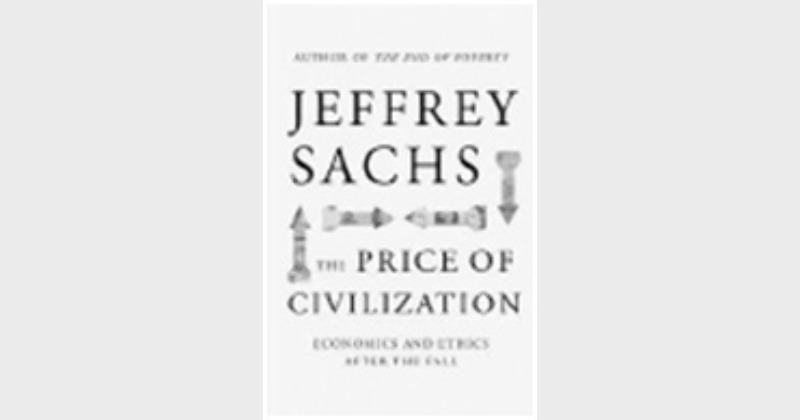
The Price of Civilization: Economics and Ethics After the Fall, Jeffrey Sachs,  The Bodley Head, Random House, Pp 326  (PB),  £14.99

America has been exporting its economic model, its cultural values and much else to the rest of the world, most of them willing and eager receivers. But today, America stands at a crossroad, confused, almost terrified, of what has happened to it. Most Americans, who blindly trusted their politicians and their broker-agents got a rude shock when the money castle around them tumbled like the proverbial pack of cards. Since then, many books have come trying to unravel the crash and after.

Jeffrey Sachs in his The Price of Civilization – Economics and Ethics After the Fall has brilliantly analysed the current rudderless situation America finds itself in and offers effective solutions. A deeply drenched economist, who still believes that economics is not about getting richer alone but touches every aspect of the society including its moral and ethical cores. And that is precisely what America has lost, he says. “America’s weaknesses are waning signs for the rest of the world. The society that led the world in financial liberalization, round-the-clock media saturation, television-based election campaigns, and mass consumerism, is now revealing the downside of a society that has let market institutions run wild over politics and public values.”

Sachs points out that the emerging economies are aping America as “American political advisors now fan out to all parts of the world to advise candidates on American-style media manipulation.” With the result that the ills that plague America are now following others: inequality, corruption, corporate power, environmental threats, and psychological destabilisation.

Squarely blaming the take over of governance by the corporate sector, Sachs says both Democrats and the Republicans are in their hands. The only difference is that Big Oil own the Republicans while Wall Street owns the Democrats. Quite a scathing remark. Sachs dismisses the Obama governance in one short crisp sentence that sums up his angst: “I looked to Barack Obama as the hope for a breakthrough. Change was on the way, or so we hoped; yet there has been far more continuity than change.” The administration is packed with individuals passing through the revolving door that connects the Wall Street with the White House, he adds. Today, majority of Americans do not trust their government, says Sachs quoting surveys. They believe that the government serves the interests of the corporate more than it bothers with the ordinary citizens.

Sachs sees the decline in the quality of human capital in the US as the biggest threat facing the nation. Quoting studies he exposes how an average American student, both at school level and at college level, has fallen far behind international standards, with the Asians taking the lead. The author also discusses the divisions running through America: between the red states and the blue states; suburbs versus the urban; whites versus the minorities; sunbelt versus the snowbelt …. These divisions are real and need to be addressed and sorted out.

Economists world over have been lauding the process of globalisation, with India no exception. But Sachs has a different view on this. He says the forces of globalisation were permitted, and even perversely encouraged, to widen the inequalities of wealth and income. He in fact urges the rest of the world to learn from America’s mistakes.

The American people are generally broad-minded, moderate, and generous, says the author, but these are not the images of Americans we see on televisions, he rues.

Sachs advocates the creation of a mindful society one that promotes the personal virtues of self-awareness and moderation, and the civic virtues of compassion for others. Through a return to personal and civic virtue, our lost prosperity can be regained.

“We are paralyzed, rather , by a shared lack of serious attention to our future.” The US Congress has become a “millionaire’s club, with 261 members, almost half, of today’s Congress holding at least $1 million in assets.”

He recommends Seven Habits of Highly Effective Government. They are: Set clear goals and benchmarks; mobilize expertise; make multilayer plans; be mindful of the far future; end the coporatocracy; restore public management; decentralize.

The book gets at times emotional, and Sach’s pleas for change are impassioned. Is anybody listening in America? Sachs is the Director of the Earth Institute and Professor of Health Policy and Management at Columbia University. He is also special advisor to UN Secretary General and is the author of The end of Poverty.

(Random House, 20 Vauxhall Bridge Road, London SW1V 2SA)

ShareTweetSendShareSend
✮ Subscribe Organiser YouTube Channel. ✮
✮ Join Organiser's WhatsApp channel for Nationalist views beyond the news. ✮
Previous News

Focus on border area development, for national security

Next News

36 families in 8 villages in Jaunpur return to Hindu fold

Related News

Representative Image

Pakistan slipping into authoritarian rule, warns the lawyers of the country

Representative Image

China-Japan face-off escalates across Indo-Pacific: An emerging threat to the peace & security of the maritime domain

Defence Minister Rajnath Singh(File Photo)

Defence Minister unveils Galwan War Memorial; Hails border connectivity as key to success in Operation Sindoor

UMEED Portal

UMEED Portal deadline ends: Logs 5.17 lakh Waqf properties, with 2.16 lakh approved, 2.13 lakh pending, 10,869 rejected

R. Sreelekha IPS (Retd.)

Kerala: Interview with R. Sreelekha IPS (Retd.) — BJP’s Thiruvananthapuram Municipal Corporation Candidate

How Nehru Torpedoed Vande Mataram: The Untold Story

Load More

Comments

The comments posted here/below/in the given space are not on behalf of Organiser. The person posting the comment will be in sole ownership of its responsibility. According to the central government's IT rules, obscene or offensive statement made against a person, religion, community or nation is a punishable offense, and legal action would be taken against people who indulge in such activities.

Latest News

Representative Image

Pakistan slipping into authoritarian rule, warns the lawyers of the country

Representative Image

China-Japan face-off escalates across Indo-Pacific: An emerging threat to the peace & security of the maritime domain

Defence Minister Rajnath Singh(File Photo)

Defence Minister unveils Galwan War Memorial; Hails border connectivity as key to success in Operation Sindoor

UMEED Portal

UMEED Portal deadline ends: Logs 5.17 lakh Waqf properties, with 2.16 lakh approved, 2.13 lakh pending, 10,869 rejected

R. Sreelekha IPS (Retd.)

Kerala: Interview with R. Sreelekha IPS (Retd.) — BJP’s Thiruvananthapuram Municipal Corporation Candidate

How Nehru Torpedoed Vande Mataram: The Untold Story

Bangladeshi army officer and senior BNP leader Col Abdul Haque

A former Bangladeshi army officer & BNP leader urges youth to get army training to sever Northeast from India

PM Narendra Modi on Vande Bharat

“Removal of significant verses in Vande Mataram sowed seeds of partition”: PM Modi

West Bengal: Sanatan Sanskriti Sansad’s Gita Path Sees 6.5 Lakh Hindus Recite the Gita in Kolkata

(L) Panakkad Munavarali Shihab Thangal (R) Fathima Nargese

Kerala: Muslim League leader’s 16 years old daughter Fathima Nargese backs women entry into Mosques, father disputes

Load More
  • Privacy
  • Terms
  • Cookie Policy
  • Refund and Cancellation
  • Delivery and Shipping

© Bharat Prakashan (Delhi) Limited.
Tech-enabled by Ananthapuri Technologies

  • Home
  • Search Organiser
  • Bharat
    • Assam
    • Bihar
    • Chhattisgarh
    • Jharkhand
    • Maharashtra
    • View All States
  • World
    • Asia
    • Africa
    • North America
    • South America
    • Europe
    • Australia
  • Editorial
  • Operation Sindoor
  • Opinion
  • Analysis
  • Defence
  • Culture
  • Sports
  • Business
  • RSS @ 100
  • Entertainment
  • More ..
    • Sci & Tech
    • Vocal4Local
    • Special Report
    • Education
    • Employment
    • Books
    • Interviews
    • Travel
    • Health
    • Politics
    • Law
    • Economy
    • Obituary
  • Subscribe Magazine
  • Read Ecopy
  • Advertise
  • Circulation
  • Careers
  • About Us
  • Contact Us
  • Policies & Terms
    • Privacy Policy
    • Cookie Policy
    • Refund and Cancellation
    • Terms of Use

© Bharat Prakashan (Delhi) Limited.
Tech-enabled by Ananthapuri Technologies