





Alternative approach to harness women power?
Jayant Patel?
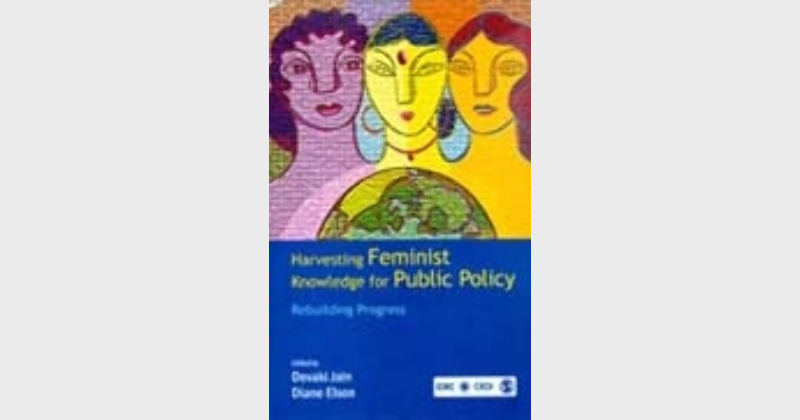
 Harvesting Feminist Knowledge for Public Policy in Rebuilding Progress, Devaki Jain and Diane Elson (Eds.), Sage Publications, Pp 396 (HB), Rs 795?
Women throughout the world remain among the poorest and most marginalised with limited access to rights, resources and opportunities. They continue to suffer multiple forms of discrimination and endure psychological and physical violence. In such a scenario, it’s necessary to tap women’s potential. We must spare no effort to implement women’s rights, to find practical and effective ways to relieve their suffering and redress the injustice that hampers, belittle and suppresses their contribution.
Containing 14 writings by feminist thinkers from different parts of the world, this book reflects on problems of current patterns of development and argues for political, economic and social changes to promote equality and sustainability. In the light of the ‘triple crises’ of food, fuel and finance (2008-2009) and of growing inequality, the writers suggest policies and priorities for reformulating development to secure social, economic and political justice. They all agree that gender inequality has to be seen with reference to other forms of inequality and that efforts for gender equality should not be divorced from efforts to promote a more equal world for all.
Some of the thinkers engage with some broad trends of contemporary development. Diane Elson focuses on how to reframe understanding of development, while stressing the need for a greater role for social investment, production and consumption. She argues for working towards a socially just economy that respects individual rights to use collectively-owned resources.
S Seguimo discusses how the neo-liberal macroeconomic policies set in motion since the early 1970s have undermined the goals of dignified work, security and inter-group equality, focusing in particular on liberalisation of the financial sector and reorientation of central banks away from employment creation.
L Beneria examines the key challenges regarding labour market trends, including the changing organisation of the labour processes, the growth of the informal economy and the reorganisation of the care economy through the feminisation of international migration.
N Otobe reviews the gender dimensions of work in a globalised economy in the context of standards and procedures agreed through the International Labour Organsiation. She calls for economic recovery programmes to bail out the working poor.
I Castaneda and S Gammage explore the impact of climate change on access to food, water and energy, discussing how women and men are differently affected and how gender inequalities intersect with adaptation and mitigation strategies.
Y Fall’s focus is on access to food and water in the light of the costs of market-driven policies for agriculture and water provision in Africa.
D Jain talks of the Indian paradox of food security behind which lie “mountains of food and millions of starving citizens” despite the large State-managed food distribution system to provide food to households beyond the poverty line, the power to the corporate sector and the objective of enhancing foreign capital inflows which have led to the growth of the real estate sector than to use of land for food production.
Certain chapters consider the pressures that have limited realisation of gender equality in development and draws on the experiences of Philippines as presented by Monsod, of Japan by Hara, of China by Chen and of Cuba by N Sarmiento.
Then there are three chapters each by R Jhabvala, P McFadden and J Silliman which focus on feminist or women-led mobilisation to achieve equality. Here the views of Jhabvala are of special importance to us in India as she emphasises that women workers in the non-formal sector, such as seen in SEWA, even though not protected by labour laws, can change the circumstances of women through collective organising.
The writers in this book offer proposals for alternative strategies to address the limitations and contradictions of currently dominant ideas and practices in development and move towards the creation of a socially just and egalitarian world.
(Sage Publications India Pvt Ltd, B 1/I-1, Mohan Cooperative Industrial Area, Mathura Road, Post Bag 7, New Delhi-110 044; www.sagepublications.com)
A gripping narrative of the trial that saved Mandela?
Jayant Patel?
 Saving Nelson Mandela: The Rivonia Trial and the Fate of South Africa, Kenneth S Brown, Oxford University Press, Pp 210 (HB), $ 24.95?
On 11 February 1990, Nelson Mandela walked out of the South African prison as a free man for the first time in 27 years. He immediately assumed the leadership role that would move South Africa from a system of apartheid to a struggling, but viable democracy. It was in 1994 that Mandela finally got the opportunity to serve as President of the Republic of South Africa under its new Constitution.
That Mandela would ever be freed was almost out of the question in 1964 when he was sent to prison under charges brought under the Sabotage Act, the violation of which carried the death penalty. South Africa, in 1963, was the product of more than 300 years of racial and ethnic conflict. European settlers began entering South Africa in the late 1600s and segregated and subjugated the native population. The apartheid South Africa government touted its judicial system as independent. In 1956, Nelson Mandela, leader of the Youth League, along with his co-defendants, was charged with treason under the ‘Treason Trial’ which went on for five years, when all that Mandela was seeking was basic human and civil rights within their country.
The 1963-64 trial of Mandela, called the Rivonia Trial, was no model for procedural justice but neither was it a ‘kangaroo court’. It was a pivotal moment in South Africa’s history and one of high drama. A team composed of lawyers of great intellect, legal ability and integrity defended the accused, who through both their statements to the court and their testimony demonstrated strength of character and devotion to a cause that even a hostile judge could not, in the end, ignore. What was particularly unusual was that the judge, before whom the case was tried, illustrated both the strength and weaknesses of the South African judicial system. The judge may well have been independent of the government and its prosecutor, but his own prejudices guided him through much of the proceedings.
Brown takes the reader to the courtroom at the imposing Palace of Justice in Pretoria where the trial unfolds through dramatic narrative that captures the courage of the accused and their defence team. The Rivonia trial had no jury and only a superficial aura of due process, combined with heavy security that symbolised the apartheid government’s system of repression. He also shows how outstanding advocacy, combined with widespread public support, in fact backfired on apartheid leaders who sealed their own fate.
The trial proved that the rights of life and dignity are the most important of all human rights. These rights were basic ones for which the Rivonia defendants were fighting and for which they were willing to give their lives if needed. Had the apartheid government killed these men, “it could have struck a blow against life and dignity from which South Africa and the world might not have recovered,” says the author and very rightly so.
The author, a professor of law at the University of North Carolina Law School, says that the story of Mandela’s fight against government repression will boost the spirits of those fighting for freedom for centuries to come.
(Oxford University Press, 198, Madison Avenue, New York, NY 10016.)?










Comments